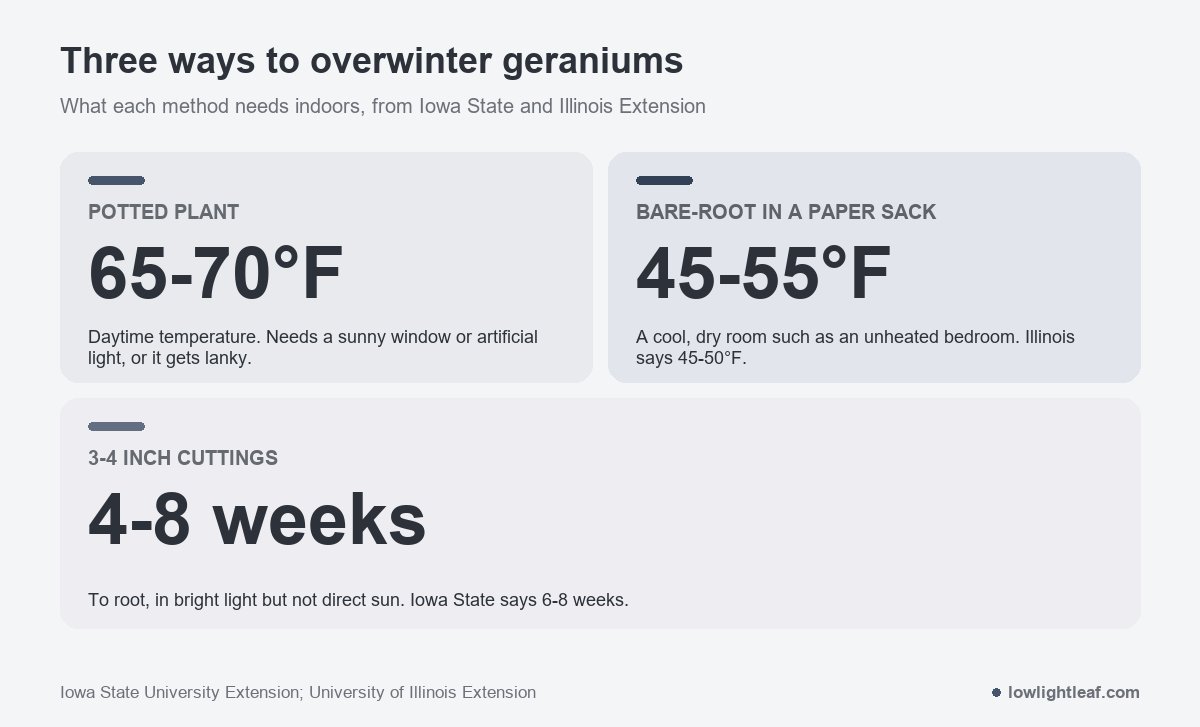
Knowing how to overwinter geraniums starts with timing: bring them in before the first fall frost, then keep them potted in a sunny window or under lights, store them bare-root in a paper sack at 45 to 55°F, or root 3- to 4-inch cuttings, Iowa State Extension says.
Overwintering geraniums leans on a different part of the house for each method. A potted geranium needs light. A paper sack needs a cool room. Cuttings need the least space of the three, and one grow light on a shelf can cover a whole pot of them.
Light or a cool room: how to overwinter geraniums in your home
The choice comes down to two questions: do you have a bright, sunny window or a grow light, and do you have a room that stays cool and dry all winter? Iowa State Extension and Illinois Extension describe the same three methods, and the answers sort them.
- A sunny window or a grow light: keep the plants potted and growing, in a room near 65 to 70°F by day.
- A cool, dry room but no good window: store them bare-root. Iowa State suggests an unheated bedroom or an indoor porch.
- Neither, but room for a grow light: take cuttings. They root in bright light out of direct sun, and once rooted both sources move them to a sunny window or under artificial light.
A north-facing apartment like the one I lived in for years has no sunny window and no cold spare room, which makes it a cuttings home. The grow lights I use for the darkest corners are the sort of artificial light both extension pages accept once the cuttings have rooted.
Whichever you choose, start early. Illinois Extension says not to wait until the last minute before frost, and to inspect each plant first. Throw out any with spotted or discolored leaves and stems, wilting, rot or insects, because those plants are hard to keep and the pests or disease can spread to other plants. If your geraniums are coming into a home already full of houseplants, that warning carries extra weight.
Potted geraniums as winter houseplants
Potted geraniums keep growing indoors over winter if they get a bright, sunny window or artificial light and daytime temperatures around 65°F, slightly cooler at night, according to Illinois Extension. Iowa State puts the ideal day range at 65 to 70°F.
- Dig each plant before the first fall frost and set it in a pot with drainage holes. Iowa State calls for a large container.
- Cut it back. Illinois prunes by one-third to one-half at this stage; Iowa State saves its hard pruning for March.
- Water thoroughly, then move it to your sunniest window or under a grow light.
- Water again only when the soil surface has dried.
- Pinch the tips now and then. Illinois says it gives well-branched, stocky plants.
Expect some stretch. Iowa State says geraniums are likely to be tall and lanky by late winter, and Illinois says they get lanky in warm rooms without enough light. In a dim window that’s the cost of this method, and the March pruning is how both sources deal with it. If your best window faces north, a grow light does the window’s job; there’s more on that in grow lights for indoor plants.
“First of all, my goodness, what a sight. As for the flowers, my mother overwinters them in the basement by a tiny window. You have to prune them to leave 10-15 centimeters, give them fertilizer, and give them plenty of light.”
– r/gardening, May 2026 (16 upvotes)
Bare-root geraniums in a paper bag
Bare-root storage needs no window at all. Iowa State’s method is to shake the soil off the roots, put one or two plants in a large paper sack and keep it in a cool, dry place at 45 to 55°F until March.
- Dig the plants before frost, or tip them out of their pots, and shake the soil from the roots.
- Put one or two plants in a large paper bag. Hanging them upside down also works; Iowa State calls that version somewhat messier.
- Store the bag somewhere cool and dry. Iowa State gives 45 to 55°F; Illinois gives a narrower 45 to 50°F.
- Leave the plants alone until March. Most leaves fall and the shoot tips die back, and both sources expect that.
“Saw that you could keep geraniums over winter in your basement. I didn’t fully think it would work but tried it anyways. Shook off all the dirt from the roots, pruned lightly and placed plants in a paper bag upside down in a dark basement. Just pulled them out an hour ago and remarkably the plant was still putting out green shoots and even a flower after 5-6months in the dark with no soil and no water!”
– r/OntarioGardeners, April 2026 (15 upvotes)
Some popular guides tell you to keep the bag somewhere damp. Both extension pages say dry.
Can you overwinter geraniums in a garage? Neither extension page mentions one. A garage fits the same rule as any other room only if it holds that 45 to 55°F band and stays dry, and a thermometer left out there for a few cold nights will answer it before the plants go in. The reverse problem is more common in apartments: a home heated evenly from room to room has nowhere that cool, so in a small, warm apartment this method may be off the table.
Geranium cuttings under a window or grow light
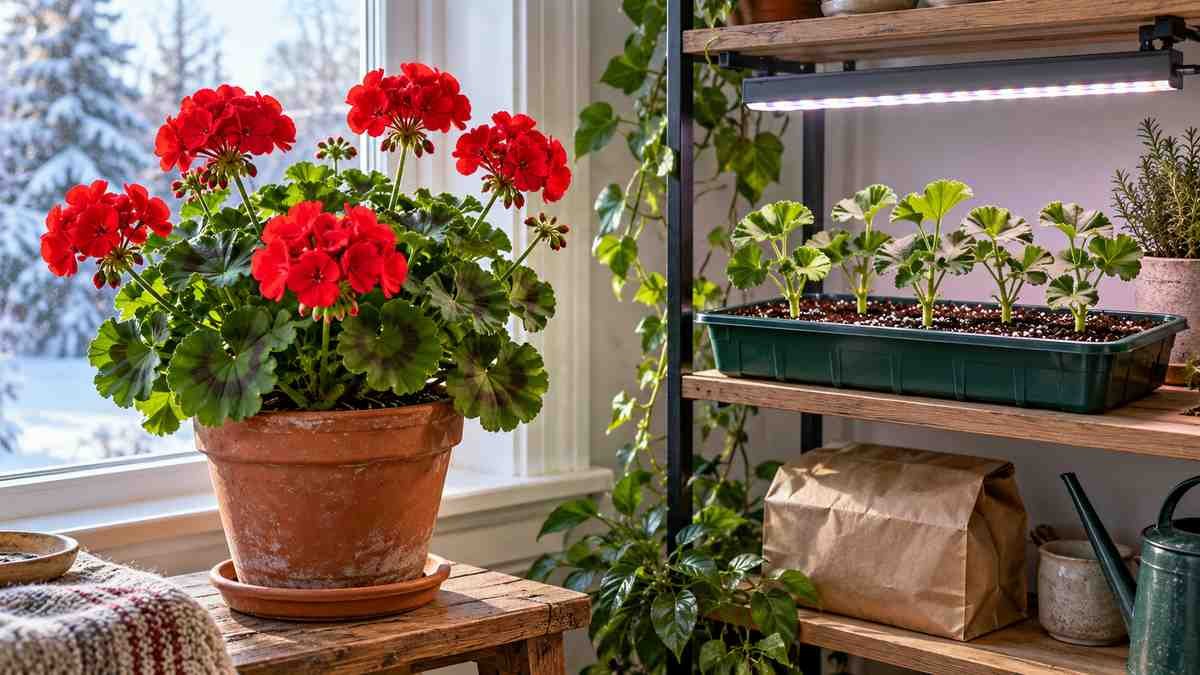
Geranium cuttings take the least room. Root 3- to 4-inch tips in vermiculite or a perlite and peat mix, in bright light but not direct sun, and expect roots in 4 to 8 weeks by Illinois Extension’s count or 6 to 8 by Iowa State’s.
- With a sharp knife or pruning shears, cut 3 to 4 inches from the ends of healthy shoots.
- Pinch off the lower leaves and dip the cut end in rooting hormone.
- Stick the cuttings into vermiculite, or perlite mixed with sphagnum peat moss, in a pot with drainage holes. Push each one in just far enough to stand on its own.
- Water, let the pot drain for a few minutes, then cover it with a clear plastic bag or dome. Illinois warns to look for mold under the bag.
- Set the pot in bright light, out of direct sun, and keep the medium moist.
- Once a cutting has a good root system, move it into its own 3- to 4-inch pot in a sunny window or under lights until spring.
One pot or flat holds several cuttings, which is why this method suits a small apartment.
“Prune it any time, and any way you like. Put the pruned pieces into a bucket of water and wait for them to make roots. Then plant them. Now you have 40 sentimental geraniums.”
– r/gardening, March 2026 (53 upvotes)
That commenter roots them in water. Both extension pages use a rooting medium instead, and the steps above follow them.
What to do with overwintered geraniums in March
March ends the indoor stretch for all three methods. Iowa State and Illinois both name May as planting-out time, which fits their Midwest climate; elsewhere, go by your own last frost date.
Potted plants. Cut them back by one-half to two-thirds, Iowa State says. They start growing again within a few days and should fill out by May.
Bare-root plants. Take them out of the bag, remove everything shriveled and dead, and prune each stem back until you reach firm, green, live tissue. Firm and green means that stem is alive. Pot the plants up, water thoroughly and put them in a sunny window or under artificial light until planting time.
Rooted cuttings. Keep them growing in their small pots in the brightest spot you have, or under lights, until they can go outdoors.
Geraniums around cats and dogs
The geraniums people overwinter are Pelargonium, which Illinois Extension notes aren’t true geraniums, and the ASPCA lists Pelargonium as toxic to dogs, cats and horses, with vomiting, anorexia, depression and dermatitis among the signs.
I look up every plant on the ASPCA list because of my cat, Miso, and geraniums sit on the toxic side of it. The safe side has its own list in pet-friendly indoor plants. Bringing them indoors puts them within reach of a pet that never got near them in the garden. A paper sack of dormant plants in a shut room stays out of a cat’s way; a potted geranium on a windowsill doesn’t.

Ellie Marsh
Houseplant grower who spent years in a north-facing apartment. Writes practical care guides for low light homes, checked against extension and botanical garden sources.