Last updated on October 11, 2026
No, spider plants are not toxic to cats. The ASPCA lists the spider plant (Chlorophytum comosum) as non-toxic to both cats and dogs, though its plant database also warns that eating any plant material can cause vomiting and stomach upset.
So are spider plants toxic to cats in any way that should worry you? Not in the poisoning sense. I share my home with a cat named Miso, and I look up every plant on the ASPCA list before it comes inside; the spider plant passes. What’s worth knowing is what “non-toxic” covers, and how to make sure the plant on your shelf is the one the ASPCA means.
Are spider plants toxic to cats, or just hard on the stomach?
Spider plants are non-toxic, so one isn’t expected to poison your cat. Chewing it can still make a cat vomit. The ASPCA says plants listed as non-toxic are not expected to be life-threatening, while the consumption of any plant material may cause vomiting and gastrointestinal upset in cats and dogs.
University of New Hampshire Extension puts it the same way. Even a non-toxic plant could still cause vomiting or stomach upset, it says, but it should not be life-threatening. That’s the honest version of “safe”: a cat that chews a few leaf tips and throws up on the rug has had a bad afternoon, not a poisoning. Call your veterinarian or the ASPCA Animal Poison Control Center at (888) 426-4435 if your cat seems ill, or if you aren’t sure which plant it chewed. The ASPCA notes that a consultation fee may apply to the hotline.
Make sure it’s really a spider plant
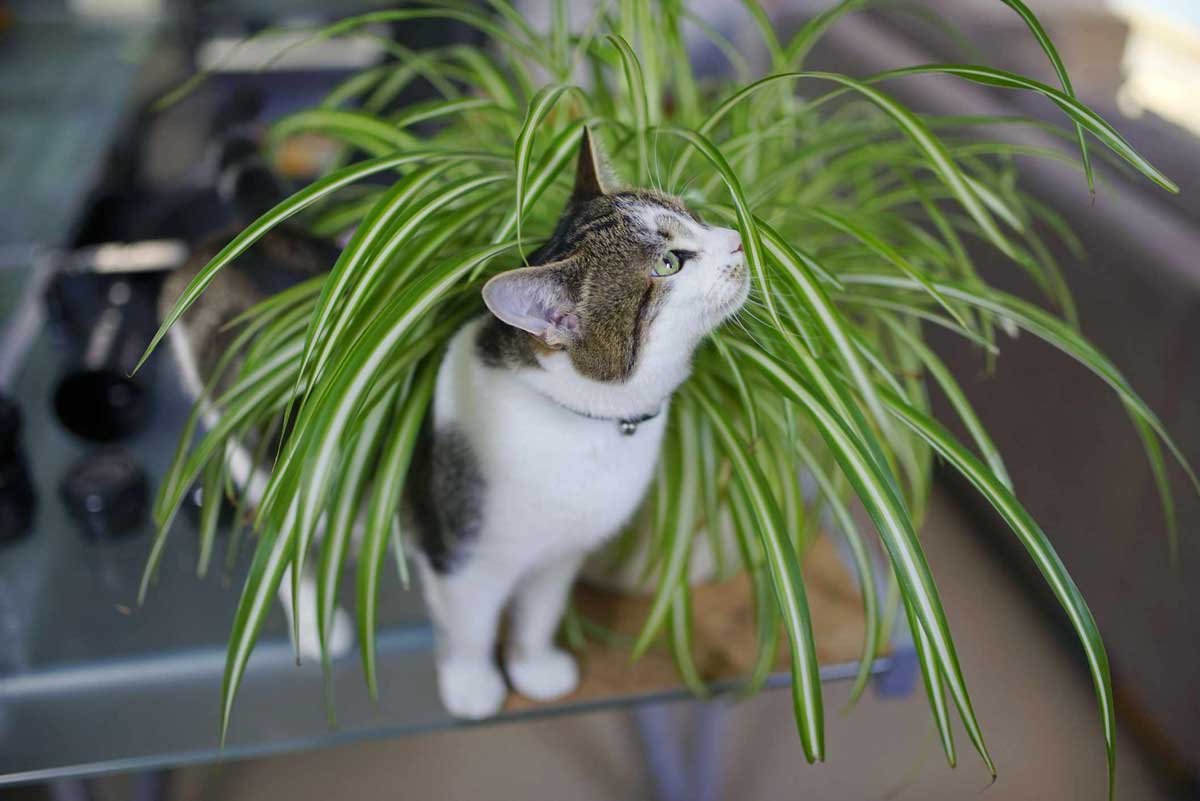
The safe verdict belongs to one plant, Chlorophytum comosum, so check the scientific name on the tag. Several plants share “spider” in their common name, and the ASPCA warns that its list isn’t all-inclusive and that plants can look different from its photos.
| Name on the tag | Scientific name | ASPCA verdict for cats |
|---|---|---|
| Spider plant, spider ivy, ribbon plant | Chlorophytum comosum | Non-toxic (also non-toxic to dogs) |
| Spider flower | Cleome hasserlana (as the ASPCA spells it) | Non-toxic |
| Queen’s spiderwort | Dichorisandra reginae | Non-toxic |
| Spider lily | Varies by plant | No entry in the ASPCA cat list; ask your vet |
| Easter lily, as an example of a true lily | Lilium longiflorum | Toxic; kidney failure and death are possible |
That last row is why the name matters.
The ASPCA says Easter lily can cause vomiting, loss of appetite, lethargy and kidney failure, and that cats are the only species known to be affected. A plant sold as a “spider lily” is not a spider plant, and since the ASPCA list has no entry for it, the safe move is to treat it as unknown until your vet says otherwise.
Why cats chew spider plants
Nobody has shown why, so far as I can find. You’ll see claims online that spider plants act like catnip or have a mild hallucinogenic effect on cats, but I couldn’t find a veterinary source or study that supports either one, so I wouldn’t repeat it as fact.
What’s easy to see is the shape of the plant. Long, thin leaves arch over the pot, and the little offshoots dangle on stems, swinging just above a cat’s reach. Whatever the reason, a plant that’s fun to bat at gets chewed.
Keeping a spider plant away from your cat
The simplest fix is to put the plant where your cat can’t reach it. University of New Hampshire Extension says it’s best practice to keep plants out of reach where possible, even the non-toxic ones, because they can still upset a stomach.
- Hang it. Spider plants trail well from a hanging basket, and a hook high enough that the offshoots don’t hang within jumping range keeps them out of play. Ideas for where to hang plants in a dim room are in low-maintenance hanging plants.
- Trim the dangling babies. The offshoots are the part that swings. Snip them off and root them, which also gives you new plants.
- Use a high shelf away from furniture your cat uses as a launch pad.
Moving the plant also changes its light. If it ends up farther from a window, the light and watering notes on spider plant care will help it settle in.
Spider plants, cats and other houseplants
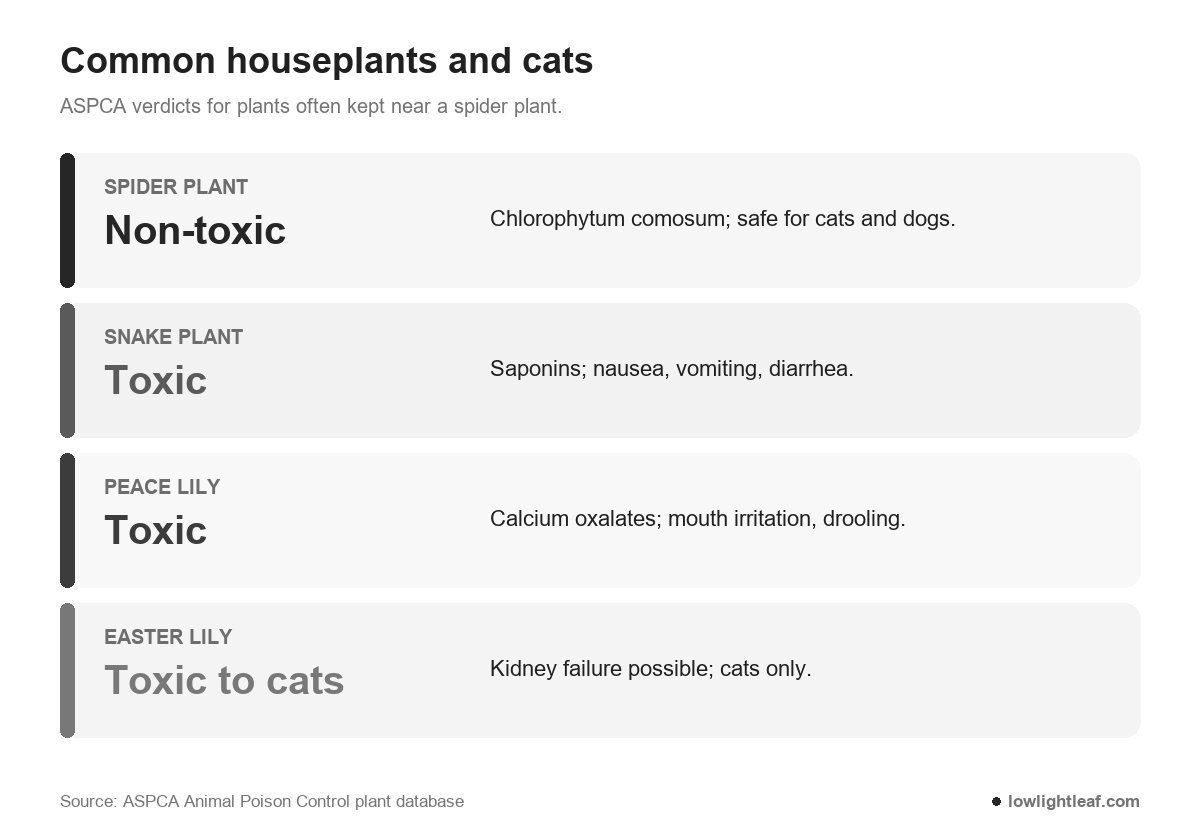
The spider plant is on the ASPCA’s non-toxic list, but two plants often kept beside it, the snake plant and the peace lily, are listed as toxic to cats; the peace lily is covered in are peace lilies toxic to cats.
Are spider plants toxic to dogs?
No. The ASPCA lists the spider plant as non-toxic to dogs as well as cats, with the same caveat that eating plant material can cause vomiting or stomach upset.
Are snake plants toxic to cats?
Yes. The ASPCA lists snake plant, under the name mother-in-law’s tongue (Sansevieria trifasciata), as toxic to cats and dogs because of saponins, with nausea, vomiting and diarrhea as the signs. If you keep both plants, the snake plant is the one to put out of reach first; growing tips are on snake plant care.
Which houseplants are safe for cats?
Start with the ASPCA’s non-toxic list and the scientific name on the tag. A shortlist that suits dim rooms is in pet-friendly indoor plants, and the same rule applies to each of them. Match the scientific name before you trust the common name.

Ellie Marsh
Houseplant grower who spent years in a north-facing apartment. Writes practical care guides for low light homes, checked against extension and botanical garden sources.