Last updated on November 13, 2026
Every ZZ plant for sale is the same species, Zamioculcas zamiifolia, sold under a handful of cultivar names. The ZZ plant varieties you’ll actually meet are the classic green (Zanzibar Gem), the near-black Raven, the dwarf Zenzi and Zamicro, the wide-leaf Lucky, and a few rare variegated types. If you want one for a genuinely dim corner, pick the plain green or the Raven.
What separates them in my north-facing apartment is how much light each type needs to keep its color. Green and black leaves cope with low light, while the white-and-cream variegated types need brighter indirect light or their pattern fades to green. That one difference drives most of the buying decision.
The ZZ plant varieties you’ll actually find
Breeders work from a single species, so the differences between types are size, leaf shape, and leaf color. Care stays the same across all of them, which is why the choice comes down to looks and light.
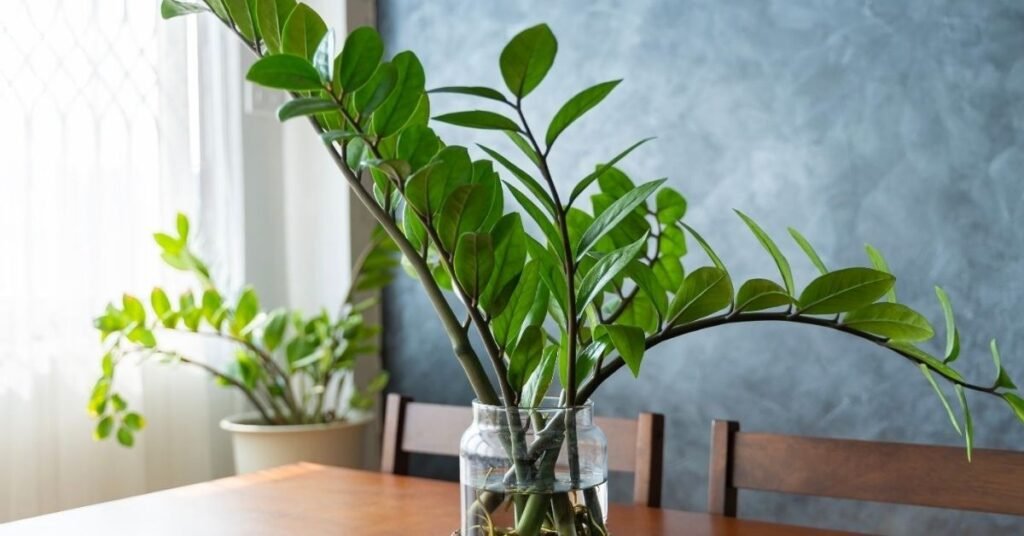
Classic green (Zanzibar Gem). The standard plant, with arching stems lined with waxy, oval, dark-green leaflets that reach 2 to 4 feet tall indoors.
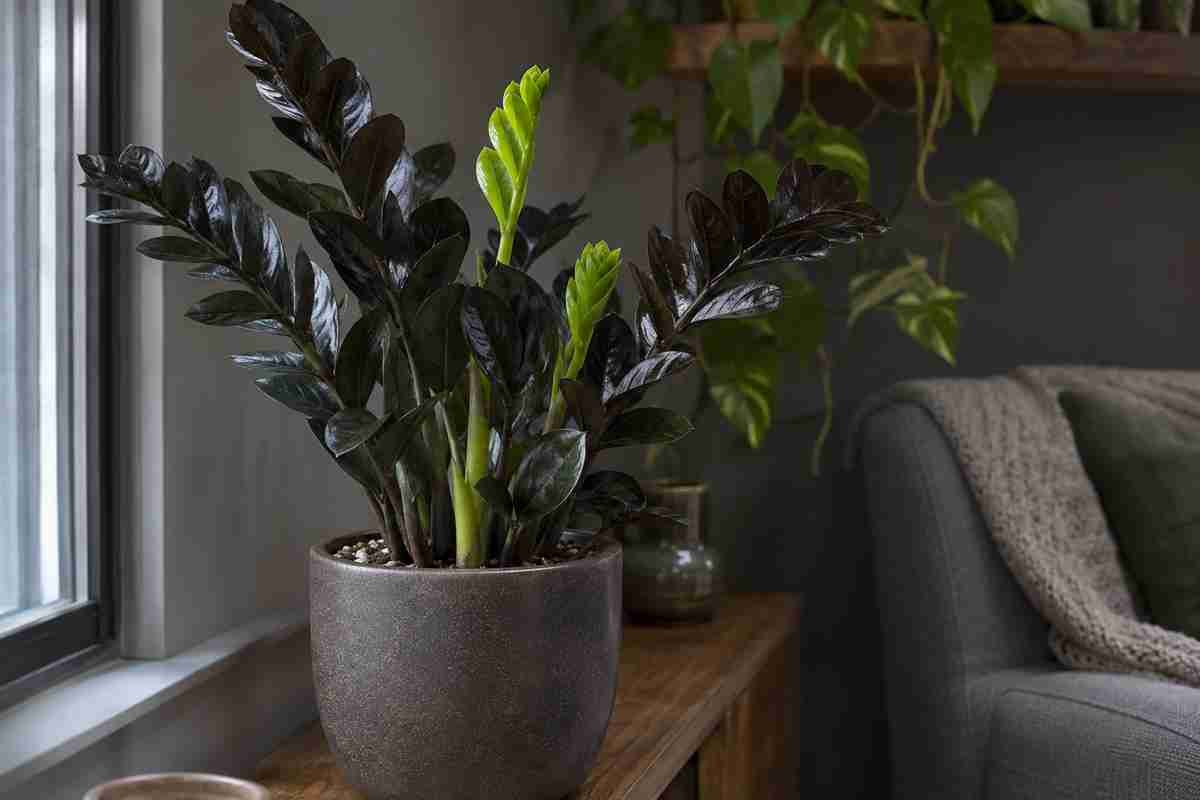
Raven (‘Dowon’). New growth opens lime green and darkens to a glossy purple-black over a few weeks, so one plant shows two colors at once. It stays a little more compact, around 2 to 3 feet, and it carries a U.S. plant patent that matters if you plan to propagate it.
Zenzi. A dwarf with thick, closely packed leaves that curl slightly, topping out around 1 to 2 feet. Sized for a shelf or a desk.
Zamicro. An even smaller, slower type with narrow leaflets, staying under about 2 feet.
Lucky (wide-leaf). A fuller-looking plant with rounder, wider, thicker leaflets than the classic green, so it reads as more tropical.
Variegated types (Variegata, Akebono). Rare collector plants with white, cream, or gold patches. Akebono leans gold-yellow; Variegata runs white and cream. They cost more, and they need more light to hold the pattern.
Which ZZ variety handles the dimmest room
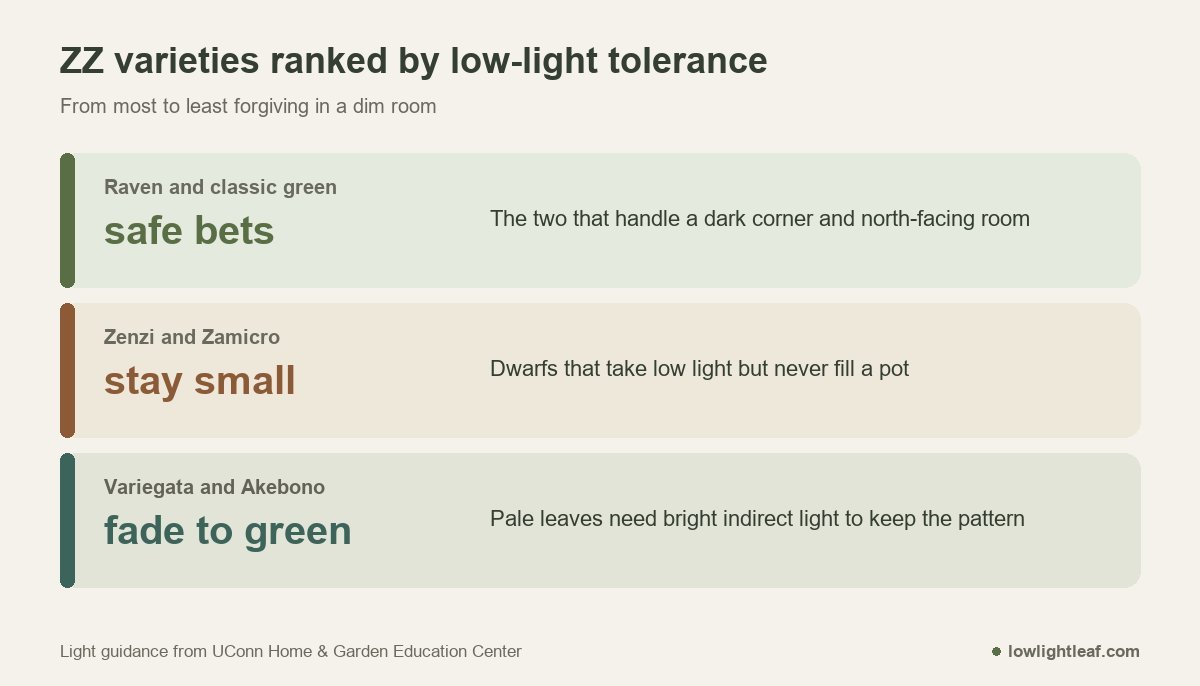
The plain green ZZ and the Raven are the two safe bets for a dark corner. Both tolerate the low light of a north-facing room and even a windowless office under fluorescent bulbs, according to the University of Connecticut’s Home & Garden Education Center.
I keep both in my dim rooms, where they hold their green and black without a grow light. What “tolerates low light” does not promise is growth. A ZZ in a dim corner survives but stays small and slow; the same plant under bright indirect light pushes new stems each season. The ranking orders the main types from most to least forgiving in low light.
“Tolerates and thrives are two completely different words. It can handle being in low light, but it will not enjoy it forever. Move it to get more light. Hell, I have my ZZ right in the window.”
– r/plantclinic, June 2026 (37 upvotes)
The gap opens with the variegated types. Variegata and Akebono carry far less chlorophyll in their pale patches, so they photosynthesize less efficiently and need brighter indirect light to hold the pattern. In a dim room a variegated ZZ slowly turns plain green as it makes more chlorophyll to survive.
The dwarf Zenzi and Zamicro sit in the middle. They take low light the same way any ZZ does, but a small plant in a dark room stays a small plant, so the result reads less full than the same conditions for a green or Raven. If you want to measure a room before choosing, the DLI calculator turns your light setup into a number.
Picking the right variety for your space
Match the variety to the room, not the other way around. The short rule: green and black leaves for dark rooms, anything variegated for a bright spot.
| Your situation | Pick this | Why |
|---|---|---|
| A dark corner or north-facing room | Classic green or Raven | Both tolerate low light and hold their color |
| A bright spot with indirect light | Variegata or Akebono | They need light to keep the white or gold pattern |
| A shelf or desk with modest space | Zenzi or Zamicro | They stay under about 2 feet |
| A roomy pot for a fuller look | Lucky | Wider, rounder leaflets read more tropical |
Do ZZ varieties need different care?
Not in any way that changes your routine. All ZZ varieties want the same watering (let the soil dry out between), the same loose mix, and the same temperature; the full care walkthrough lives in the ZZ plant care guide. Light is the one lever that differs, and only for the variegated types.
For the green, black, and dwarf types, indirect light is ideal, and direct sun is the thing to avoid because it scalds the leaves and turns them yellow. A variegated ZZ needs brighter indirect light than a green one, but still no hot direct sun, which burns the pale parts first.
ZZ plant varieties FAQs
How many ZZ plant varieties are there?
Seven main ZZ plant varieties turn up in shops: classic green, Raven, Zenzi, Zamicro, Lucky, and the two variegated types Variegata and Akebono. Collectors name more, but the rest are rare or just re-badged versions of these.
How large do ZZ plants grow?
A classic green ZZ reaches 2 to 4 feet tall indoors, Raven stays around 2 to 3 feet, and the dwarf Zenzi and Zamicro hold under about 2 feet. Growth is slow, often just a few new stems each season.
Why is it illegal to propagate a ZZ plant?
The restriction is specific to newer patented cultivars, not every ZZ. Raven (‘Dowon’) carries U.S. Plant Patent PP30,035, so asexually propagating it (cuttings, division, or leaflet cuttings) to sell is illegal without the patent holder’s permission. Growing and caring for your own plant is fine.
Are ZZ plants toxic to cats and dogs?
Yes. The ASPCA lists ZZ as toxic to cats, dogs, and horses because of calcium oxalate crystals, which irritate the mouth and can cause drooling and vomiting if chewed. Run a plant through the toxicity checker before you bring one into a home with pets.
What are the downsides of a ZZ plant?
Slow growth is the main one, along with the pet-toxicity warning. A ZZ in a dim room also bends its stems away from the light, so you may need to rotate it to keep the shape even.

Ellie Marsh
Houseplant grower who spent years in a north-facing apartment. Writes practical care guides for low light homes, checked against extension and botanical garden sources.