Good dracaena care means bright, indirect light, a mix that dries a little between waterings, and water without much fluoride. NC State Extension lists the corn plant as low maintenance and slow growing, and the ASPCA lists dracaenas as toxic to cats and dogs, so a pet owner should keep one out of reach.
I read six pages on dracaenas: NC State’s entries for the corn plant and the Madagascar dragon tree, the RHS genus guide, UF/IFAS Gardening Solutions and the ASPCA entries for both plants, plus three Reddit comments. They don’t agree on light, and they say little about propagation, so those parts are short on purpose. The RHS says the genus now includes the snake plant, but a snake plant has different needs, so the dracaena care below is for the woody, cane-forming kinds. For the snake plant, see the snake plant care guide.
How much light does a dracaena need?
Most sources say bright but indirect, and one says dracaenas cope with much less. NC State Extension says bright to moderate, filtered light for the corn plant, and the RHS says bright but indirect. UF/IFAS calls dracaena one of the best indoor trees for low-light areas, so they disagree on how low you can go.
NC State’s dragon tree entry also lists bright, indirect light as ideal.
Read what each source warns about and the disagreement shrinks. NC State’s corn plant entry says direct sun can burn the foliage. If light levels are too low, the leaves will narrow. UF/IFAS adds that a dracaena can grow as much as 18 inches a year for the first few years, but only “with sufficient light”. Low light keeps the plant alive; thin new leaves are the sign it wants more.
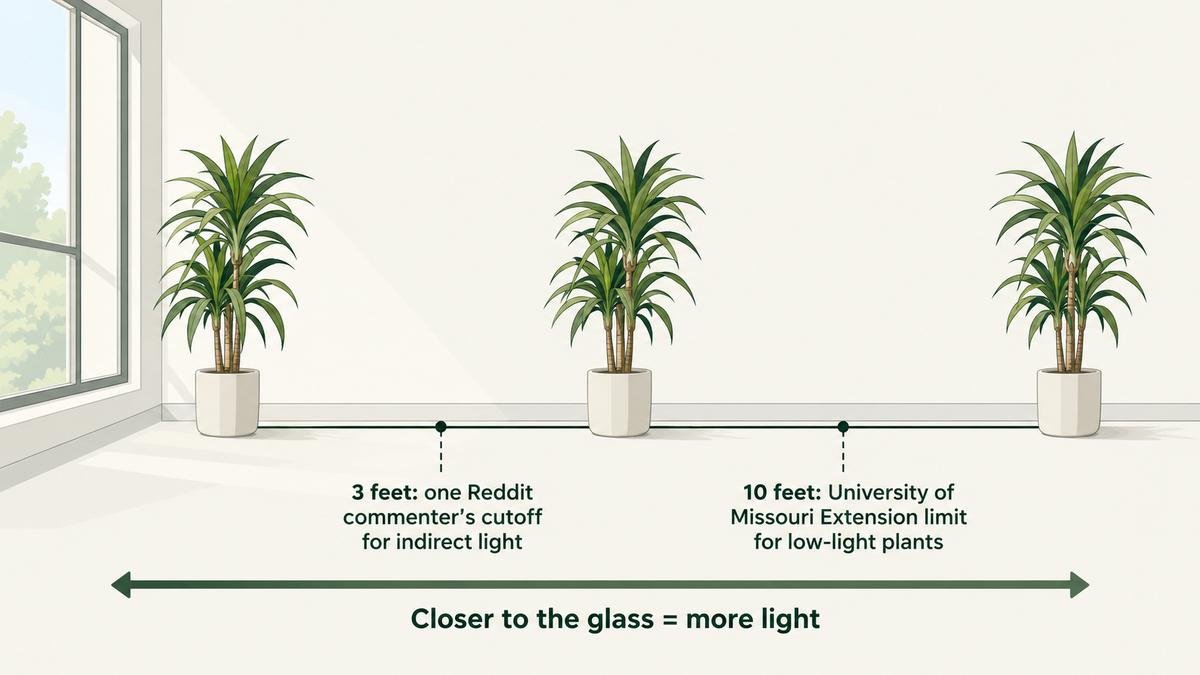
Distance from the window matters more than the word on the plant tag. One commenter in r/houseplants put it bluntly:
“Note that indoor light and outdoor light are not the same – any more than say 3 feet from a window is not indirect light – it is darkness.”
– r/houseplants (2 upvotes)
Three feet is stricter than the extension pages, which don’t give a distance for dracaena. University of Missouri Extension, in the low light indoor plants list, says even low-light plants usually don’t get enough light more than 10 feet from an average window. So I’d put a dracaena as close to the glass as the room allows without direct afternoon sun. A nursery blog, Stump Plants, names Dracaena warneckii and ‘Janet Craig Compacta’ as the better picks for dimmer spots, but that is one nursery’s opinion, not an extension finding.
If the room has no good window, a grow light is the usual fix, and the DLI calculator turns a light’s intensity and hours into a daily total you can compare between spots.
How often should you water a dracaena?
Let the mix dry somewhat between waterings, then water thoroughly. NC State says a corn plant likes moist soil in the growing season and less water in winter, while its dragon tree entry says to let the plant dry between waterings “but not severely”.
UF/IFAS says to water thoroughly, then let it dry out, and the RHS warns that the roots rot if the compost stays too wet. None of the pages gives an interval in days, so a fixed weekly schedule is a guess. A reader in r/Dracaena described exactly that setup:
“How do u take care of dracaena? Ive had it for 1 years now and it feels like its slowly dying in my ownership. Im watering it once a week ish. Repotted it in to a bigger pot half a year ago. Leaves always fall off. Help plz”
– r/Dracaena, November 2025 (29 upvotes)
The top answer was simpler than any of the care advice:
“Bottom leaves are meant to yellow and fall off to make room for new growth.”
– r/Dracaena (5 upvotes)
That fits a plant that grows from the top of a woody cane. I can’t tell from the post whether the mix was staying wet, so I wouldn’t call the weekly watering the cause. What I would do is press a finger into the mix before each watering and water only when the top has dried, which fits the “dry between waterings” advice from the NC State dragon tree entry and from UF/IFAS. If new leaves at the top look healthy, losing old ones at the bottom is ordinary.
Why are the tips of my dracaena turning brown?
Fluoride and built-up salts are the first suspects. NC State says the corn plant is sensitive to both, and advises non-fluoridated water and a monthly flush if leaves turn brown, and the RHS says fluoride in hard tap water can damage the foliage. Dry air, a nearby radiator and cold can brown the leaves too.
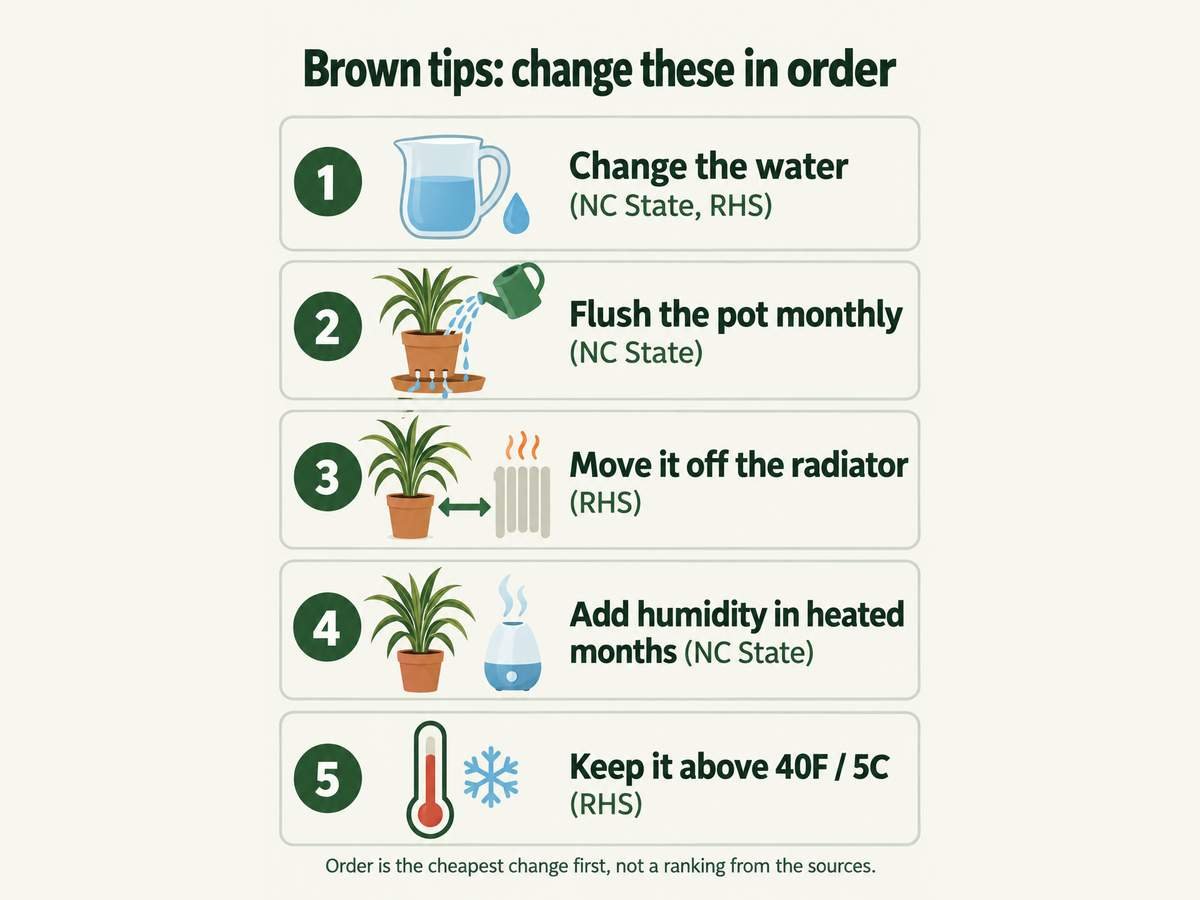
None of the pages says which cause is most common, so the order below is mine: cheapest change first.
- Change the water. NC State suggests distilled or non-fluorinated water, and the RHS suggests rainwater or filtered tap water.
- Flush the pot once a month. NC State says to flush built-up salts monthly, which means running water through the mix until it drains freely from the holes.
- Move it off the radiator. The RHS says standing a dracaena too close to a radiator in winter browns the foliage.
- Add humidity in heated months. NC State says leaves can brown at the tips if indoor humidity is too low, and that a humidifier may help in winter.
- Keep it out of the cold. The RHS says periods below 40°F (5°C) can harm these tropical plants.
Cut off brown tips with clean scissors if they bother you, since they won’t turn green again, but the cause is what decides whether the next leaf browns.
Which dracaena do you have: Janet Craig, corn plant or dragon tree?
Janet Craig is a cultivar of the corn plant, Dracaena fragrans, and the dragon tree is a separate species. A tag that says deremensis, fragrans, corn plant or Janet Craig can describe the same kind of plant.
NC State says D. fragrans was previously called Dracaena deremensis. A UK retailer, Hortology, still files Janet Craig under D. deremensis, while the RHS lists it under D. fragrans.
| Look at | Janet Craig | Corn plant | Madagascar dragon tree |
|---|---|---|---|
| Botanical name | Dracaena fragrans ‘Compacta’ (NC State) | Dracaena fragrans (NC State) | Dracaena reflexa var. angustifolia, formerly D. marginata (NC State) |
| Leaves | Solid green, dense clusters of short leaves with wavy margins (NC State) | Strap-like, 1 to 4 inches wide and 12 to 18 inches long; white or lime-green stripes are more common than plain green (NC State) | Narrow leaves (NC State), green edged in purplish-red (UF/IFAS) |
| Indoor height | 3 to 6 feet (NC State) | 3 to 14.5 feet (NC State) | Up to 6 feet indoors, can be pruned smaller (NC State) |
| Water | Moist in the growing season, less in winter (NC State, corn plant entry) | Moist in the growing season, less in winter (NC State) | Dry between waterings but not severely (NC State) |
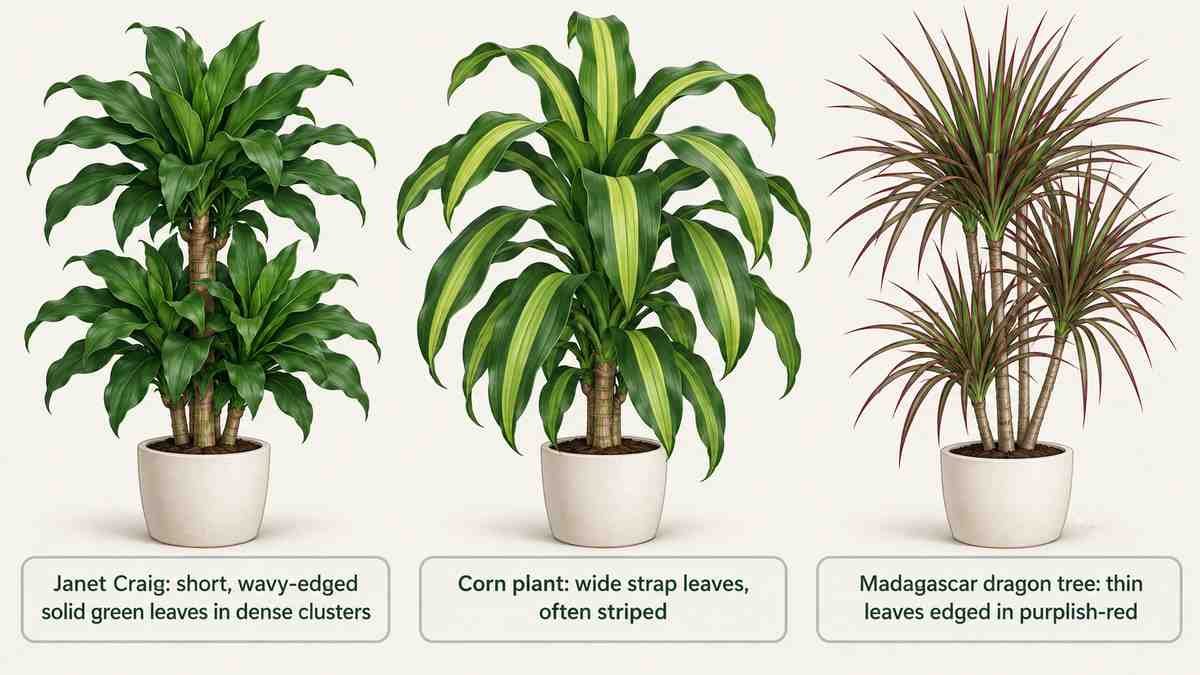
No page I found lines the three up like this, so the table is my own assembly. The plain way to tell them apart is the leaf: a wide strap with stripes points to the corn plant, a compact solid green plant with short wavy leaves points to Janet Craig, and thin red-edged leaves point to the dragon tree.
How big does a dracaena get indoors?
Janet Craig runs 3 to 6 feet and a dragon tree grows to about 6 feet as a houseplant, while a corn plant can go much higher: NC State lists 3 feet to 14 feet 6 inches. NC State adds that a dragon tree can be pruned smaller, and that pruned stems usually grow two or more branches.
The sources split again on speed. NC State gives the corn plant a slow growth rate, while UF/IFAS says a dracaena can add up to 18 inches a year for the first few years with sufficient light. Both can be true, since UF ties its figure to sufficient light and NC State doesn’t say what light its rating assumes. I’d treat 18 inches as the ceiling for a bright window and expect much less in a dim corner.
Dracaena care: what soil, pot and temperature does it want?
Use a pot with drainage holes, a regular potting mix, and keep the room above 50°F. NC State says commercial potting soil, while the RHS prefers an ericaceous, peat-free compost because dracaenas like slightly acidic conditions.
I’d start with a regular bagged mix for dracaena care and let the tips tell me if the plant disagrees.
NC State says to repot when the plant starts to lift out of the pot or sends roots out of the drainage hole. To work out how much mix a bigger pot needs, the potting soil calculator does the arithmetic for round and square pots.
On temperature, NC State says to keep a corn plant above 50°F if possible and that it thrives at 70 to 80°F, while the RHS says at least 65°F (18°C). For feeding, NC State says the dragon tree has a low fertilizer requirement and suggests a controlled-release formula in spring, summer and fall. For pests, NC State lists thrips and mealybugs on the corn plant and mites, thrips and leaf spot on the dragon tree, and UF/IFAS names mealybugs and scale as occasional problems.
Outdoors is a zone question. NC State lists the corn plant for USDA zones 10a to 11b, and UF/IFAS says gardeners in south Florida, zones 10b to 11, can grow a dragon tree outside. Anywhere colder, the 40°F limit above means it comes indoors for winter.
Does a dracaena clean the air?
Not in a way you’d notice at home. Iowa State University Extension says houseplants have little effect on air quality in a real home, even though a 1989 NASA test found plants removed pollutants inside small sealed chambers.
Retailers often list air purifying as a reason to buy a dracaena, so that claim is worth setting aside. Buy one for its shape and its tolerance of dim light, and keep it for those reasons.
How do you propagate a dracaena?
With stem cuttings. NC State’s corn plant entry says to propagate that way, and its dragon tree entry notes that a pruned stem usually grows new branches.
Pruning and propagating can happen in the same job. I found no extension page that gives rooting steps or a timeline for dracaena, so I won’t give a number of weeks.
Are dracaenas toxic to cats and dogs?
Yes. The ASPCA lists the corn plant and the Madagascar dragon tree as toxic to dogs, cats and horses, with saponins as the toxic principle. The signs it lists are vomiting (occasionally with blood), depression, anorexia, hypersalivation and, in cats, dilated pupils.
NC State rates the poison severity of both plants as low. I wouldn’t read that as safe, because the ASPCA puts them on the toxic list for pets, and with Miso in the house I check every plant against that list before it comes home. Snake plant is also in this genus and has the same toxic principle, and its answer in full is in Is snake plant toxic to cats?. For any other plant, the plant toxicity checker shows the ASPCA listing for cats and dogs. If a pet has chewed a dracaena, call your vet or the ASPCA Animal Poison Control Center at (888) 426-4435.
The top of the plant tells you more than the bottom does. If new growth is thin and narrow, move it toward the window; if the tips are brown, change the water first.

Ellie Marsh
Houseplant grower who spent years in a north-facing apartment. Writes practical care guides for low light homes, checked against extension and botanical garden sources.