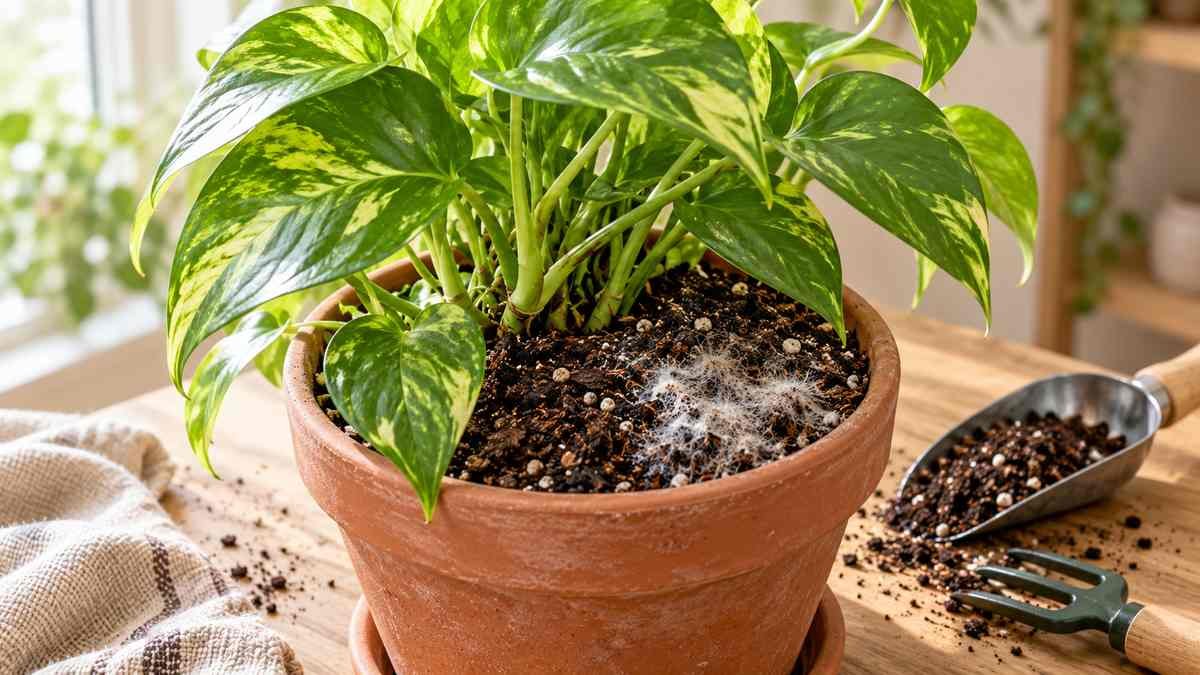
White or gray fuzz on top of a houseplant’s soil is usually a harmless surface fungus feeding on the organic matter in the mix. It means the top of the pot is staying wet too long. Let the top 1 to 2 inches dry between waterings, then break the layer up with a fork or scoop off the top layer, the fix University of Maryland Extension recommends.
Before you treat mold in plant soil, check that it is mold. A hard white crust, a cluster of yellow mushrooms and a blob of yellow slime all turn up on the same pots, and each one calls for a different response. Two of them need nothing more than patience.
White fuzz, crust, mushrooms or slime: which one you have
Match what you see to the list below. The texture matters more than the color: fuzz is soft and lifts off, a crust is hard and gritty, and slime is wet.
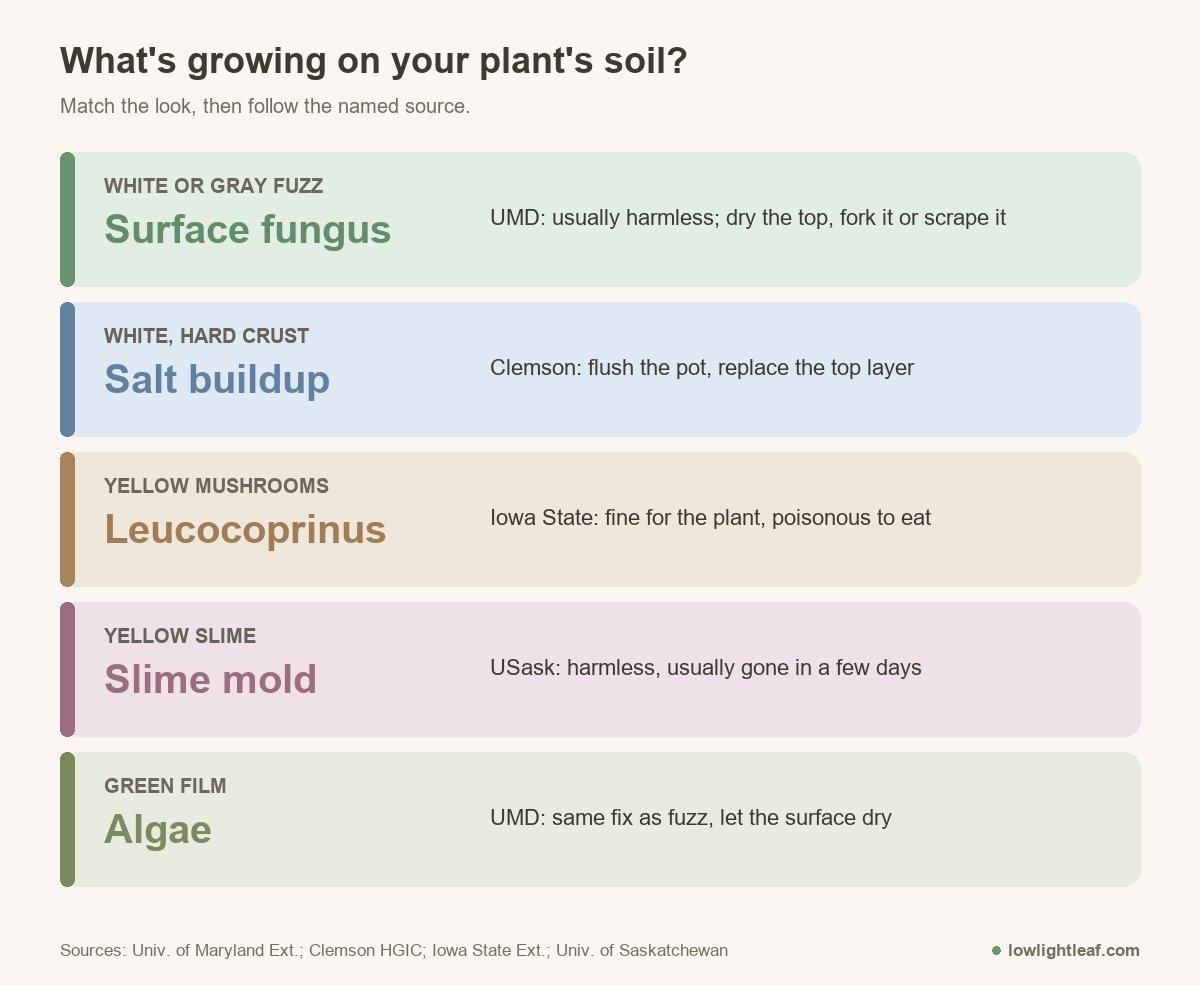
- Soft white or gray fuzz. University of Maryland Extension describes fungi that grow on the surface of potting mix under moist conditions as a white to grayish layer, and says the growth isn’t usually detrimental to plants. Iowa State University Extension makes the same call about whitish or brown molds on peat pots: unsightly, harmless to healthy seedlings, and a sign of too much moisture.
- A hard white crust on the soil or the pot rim. That’s salt, not mold. Clemson’s Home & Garden Information Center says white to gray crusty deposits mean salt buildup from fertilizer and tap-water minerals, and specifically tells readers not to confuse them with the white or yellow mold-like growth of soil fungi. Its fix is to flush the pot with plenty of water now and then, scrape off the crust, and add fresh soil.
- Small lemon-yellow mushrooms. This is almost certainly the yellow houseplant mushroom, Leucocoprinus birnbaumii. Iowa State puts them at about 1 to 3 inches tall with oval or bell-shaped caps, and UMass Extension says the caps fade to white as they age.
- Bright yellow slime. A slime mold, a fungus-like decomposer. The University of Saskatchewan says it dries to a burnt orange and usually disappears in a few days.
- A green film. Algae. Maryland says it grows in the same wet conditions as the fungus, often alongside it, and takes the same fix.
- Cottony white tufts on the leaves, stems or roots. Not a soil problem. The UC Statewide IPM Program says mealybugs cover themselves in cottony, powdery or waxy material and can live on roots as well as leaves, and white powder on the leaves themselves is powdery mildew, which usually won’t kill a plant.
“My vote mineral deposits! I have hard water and my drier plants look like this in the winter.”
– r/houseplants, November 2025 (480 upvotes)
In that commenter’s case the crust showed up on the drier pots, while fuzz, per Maryland, needs a surface that stays moist. The same white patch can point in opposite directions. Press it with a fingertip before you decide which way to adjust the watering.
Is mold in plant soil harmful to you, your pets or the plant?
Mold in plant soil is rarely harmful to the plant itself. The fuzz lives on dead organic matter, not on roots.
The danger is what it signals: Clemson says overwatering cuts the oxygen roots need and favors root rot, so a plant with fuzzy soil and soft, yellowing leaves needs its roots checked. Clemson’s rule for saving it: if only a few roots are dark and soft, cut those off and repot in fresh soil; if most are, the plant is usually past saving.
Maryland flags two indirect risks. A thick mat can dry into a crust that sheds water, so the pot looks watered while the roots stay dry. And the mat feeds fungus gnats and shore flies, whose larvae chew roots and whose adults can carry disease spores from pot to pot.
For people, the EPA says molds produce allergens and irritants, and inhaling or touching mold or its spores may cause allergic reactions in sensitive people, including asthma attacks in those allergic to mold. A patch of fuzz on one pot isn’t a damp wall, but if you’re mold-sensitive, take the pot outdoors or to a sink before you scrape it. Slime-mold spores are worth the same care: Saskatchewan calls slime mold harmless to soil, plants, pets and people, but says its dry spores can irritate people with allergies or asthma.
The yellow mushrooms are the one growth to pick off. Iowa State University Extension says they don’t harm living plants, but the mushrooms are regarded as poisonous to people and animals, so remove them as they appear if you have pets or small children. UMass adds that their exact toxicity is unknown and they should never be eaten. With Miso in the house, I’d pull them the day they show up.
“These beauties just popped up in a plant in my kitchen. Never seen one before. Apparently toxic to pets but not to the plant. I just love them. So bright!”
– r/houseplants, February 2026 (86 upvotes)
Don’t reach for a fungicide. Iowa State says fungicide treatments are generally not effective against these mushrooms, and the fungus lives in the mix as threads you can’t see, so new caps keep coming while the soil stays damp and rich.
Why the mold keeps coming back
Mold returns because the conditions that grew it are still there. Scraping the fuzz off without changing how fast the pot dries just resets the clock.
Light and season are the hidden part. Colorado State University Extension points out that shorter days and cooler temperatures slow a plant’s growth and water use, so a watering routine that worked in July keeps the mix wet in November. A pot in a dim corner works the same way all year: less light, less water used, a surface that stays damp for days. That’s why the pothos watering guide here sets the schedule by the light a plant gets, not by the calendar.
Old mix is the other cause. Colorado State says growing media retain more water as they age and break down, and that moist mixes high in peat moss draw egg-laying fungus gnats. A pot that has gone two or three years without fresh soil, sitting in a saucer of runoff, grows mold no matter how carefully you scrape it.
Getting rid of mold in plant soil, and keeping it gone
The fix is short, and none of it involves spraying anything:
- Take the pot somewhere easy to clean, outdoors or over a sink, especially if anyone in the house is mold-sensitive.
- Break up or remove the layer. Maryland’s two options: stir the mat into the surface with a fork, or scoop off the top layer of mix with the growth and throw it out. Scooping is the better pick when the mat has gone crusty.
- Let the top 1 to 2 inches dry before you water again. That’s Colorado State’s figure for fungus gnats, and drying the surface is also Maryland’s first line against mold and algae. Push a finger in to check.
- Empty the saucer after watering and make sure the pot has a drainage hole.
- Space the pots out. Maryland ties low humidity and good air circulation between pots to less surface growth.
- Repot into fresh mix if the soil is old, compacted or stays wet for a week. The guide to the best soil for pothos covers a mix that drains faster.
To check it worked, look at the surface a week after the first full dry-down. No new fuzz means the moisture is fixed. If gnats were part of the picture, Colorado State’s test is to press a quarter-inch slice of raw potato into the soil; larvae move to it within a few days, so a clean slice is a good sign.
Sealed terrariums are the exception, since they’re meant to stay humid; mold inside a jar has its own causes, covered in the guide to closed terrarium plants.
Short answers
Does cinnamon kill mold on plant soil?
Cinnamon has some evidence against fungi, but it comes from crops and stored produce, not houseplant pots. A 2021 review in the journal Molecules collected studies showing cinnamon and its compounds hinder fungal growth in crops and stored produce, and also noted phytotoxic effects strong enough to make it a possible herbicide. It doesn’t change why the soil is wet, so the fuzz comes back.
“It’s false info. Succulents usually prefer inorganic, chunky soil, cinnamon is a fine-ground, organic component. At best, you have the right soil and it washes out over a couple of waterings Nothing beats proper soil and watering frequency.”
– r/succulents, August 2026 (13 upvotes)
Should you pour hydrogen peroxide on moldy soil?
No extension service cited here recommends a hydrogen peroxide drench for houseplant soil. Asked about a homemade bleach drench for gnats, University of Illinois Extension replied that remedies like it are rarely, if ever, researched, and that it doesn’t support them. NC State Extension lists hydrogen peroxide among the disinfectants greenhouses use against soilborne disease, which suggests a better job for it: cleaning an old pot before you repot.
Can you still use moldy potting soil?
You can usually still use a bag of potting mix with white threads or fuzz in it. UMass Extension notes the yellow houseplant mushroom sometimes turns up in bags of soilless media, and Iowa State says whitish molds on organic potting materials won’t harm healthy seedlings. Dry the mix out, pick off any mushrooms, and wear a mask while you pour it if mold bothers your breathing.

Ellie Marsh
Houseplant grower who spent years in a north-facing apartment. Writes practical care guides for low light homes, checked against extension and botanical garden sources.