Last updated on October 16, 2026
The best soil for snake plant is a free-draining mix: cactus potting mix straight from the bag, or regular potting mix cut with grit, coarse sand or perlite. Penn State Extension recommends “a cactus potting mix or one with perlite,” and the Royal Horticultural Society suggests cactus compost or two parts loam-based compost to one part horticultural grit.
I’ve lived for years in a north-facing apartment, so I think about soil in terms of how long it stays wet. Where the plant sits decides how fast its soil dries, and that should decide the mix too.
Pick the mix by how much light the plant gets
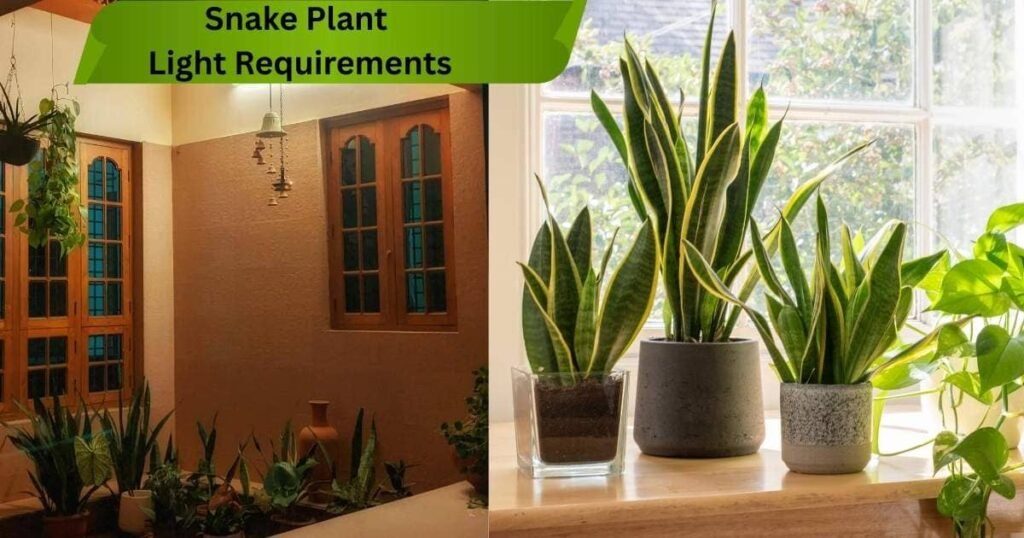
A snake plant in a dim spot needs the leanest, fastest-draining mix, because its soil stays wet the longest. University of Minnesota Extension notes that plants in less light grow more slowly and use less water. Penn State, Mississippi State and NC State all name overwatering as the main threat to these plants, so slow-drying soil is the real risk.
| Where it sits | How fast the soil dries | Mix I’d use | Pot |
|---|---|---|---|
| Dim corner, or a few feet back from a north window | Slowest; the plant uses less water in less light (Minnesota) | Cactus mix straight from the bag (Penn State, RHS, Mississippi State), or the RHS blend of 2 parts compost to 1 part grit | Unglazed clay or terracotta, which dries faster (NC State), only slightly larger than the old pot (RHS) |
| Medium light, near a window with no direct sun | In between | Cactus mix, or the RHS 2:1 compost and grit blend | Clay or plastic, always with drainage holes |
| Bright window, out of harsh direct sun | Fastest of the three | Penn State’s other option, potting mix with perlite, or Clemson’s 2 peat : 1 perlite : 1 coarse sand | Any pot with holes; a heavy one for tall plants (Penn State) |
The pairing is my judgment, not a rule any single source states. The sources supply the ingredients and the ratios, and Minnesota’s point about light and water use tells you which end of the range to pick.
Not sure which row you’re in? Push a finger into the soil before you water, as the RHS suggests. If it’s still damp days later, treat the spot as slow-drying and go lean.
Three snake plant soil mix recipes
If you want to mix your own, these three ratios come straight from extension services and use materials sold at any garden center.
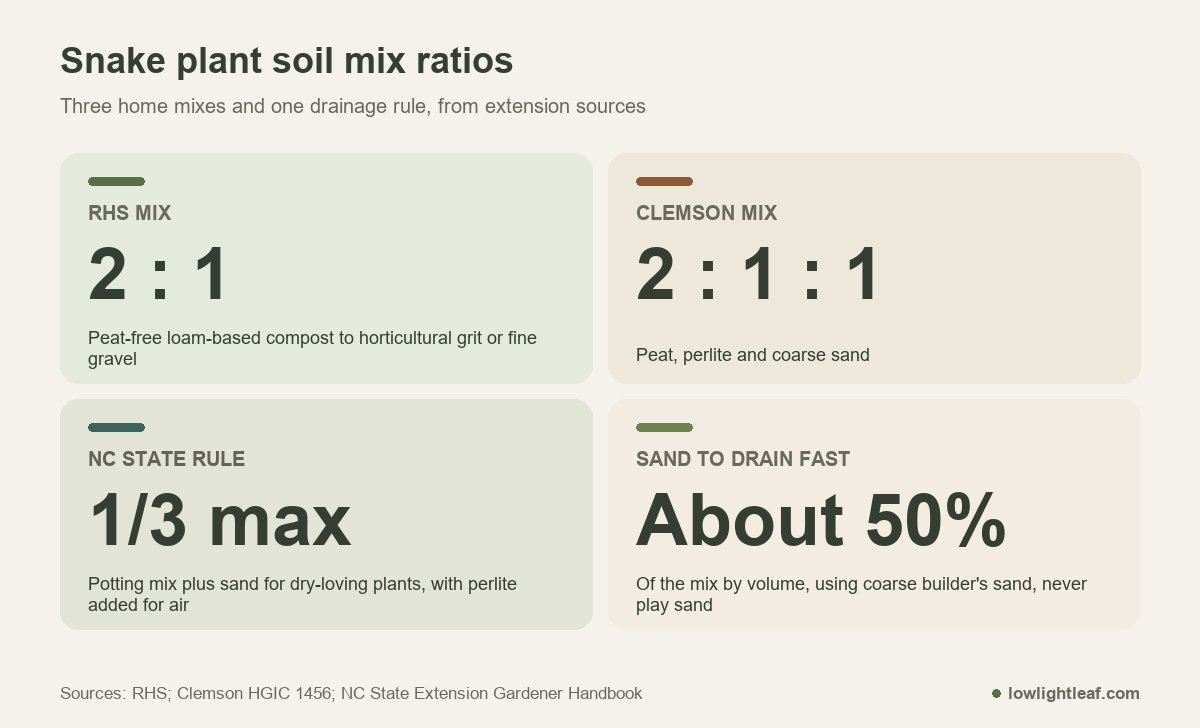
- RHS, the simplest: two parts peat-free loam-based compost to one part horticultural grit or fine gravel. Loam is soil, so this also fits the UF/IFAS note that the plant grows best in a soil-based potting mix.
- Clemson, for foliage plants: two parts peat, one part perlite and one part coarse sand. Clemson lists it as a general foliage mix, not one written for snake plants, so I’d keep it for brighter spots.
- NC State, for plants that prefer to stay dry: keep potting mix and sand to no more than a third of the blend, and add perlite for air space. NC State gives this rule for succulents, cacti and other root-rot-sensitive plants, and Penn State counts snake plant as a succulent houseplant.
Measure by the scoop or the cup, and moisten the mix slightly before potting. NC State warns that peat or pine bark that dries out completely is very hard to rehydrate.
Owners who’ve moved to grittier blends make the same point about indoor drying times:
“Unless this is going in greenhouse conditions I would make it more gritty. I feel like this soil will take a very long time to dry out in regular household conditions. My snake plants are in equal parts soil, perlite, horticultural charcoal, & crushed granite (chicken grit). It’s the same mix I used for my succulents too.”
– r/SnakePlants, November 2025 (11 upvotes)
Can I use cactus soil for snake plant?
Yes. Cactus soil is the closest bagged match for a snake plant, and three sources name it outright: Penn State suggests a cactus potting mix, the RHS a free-draining cactus compost, and a Mississippi State Extension column recommends mixes blended for cactus or succulents.
Because Mississippi State names cactus and succulent blends together, either bag works. In a bright window a cactus mix may dry fast enough that you water a little more often, and that’s a fair trade for roots that never sit wet.
Regular potting soil, nursery soil and garden soil
Regular potting soil works once you cut it with grit, coarse sand or perlite. Many bagged mixes are peat-based, Clemson notes, and NC State says peat raises a mix’s water-holding capacity, the opposite of what a snake plant wants. The RHS ratio of two parts compost to one part grit is a sensible way to amend any bag.
Plenty of owners end up with the wrong bag:
“Was looking for a cactus/succulent potting mix but couldn’t find any so I got this but it feels all wrong. Feels too moist and too dense. Do I need to just take it out and get the right stuff? Also, the roots are so small, how do I help those?”
– r/SnakePlants, June 2026 (11 upvotes)
A dense bag like that can still be used. Work in grit or coarse sand at the RHS ratio and hold off on watering until the mix dries.
Nursery soil is the other worry for new owners, especially when a plant comes home from a big-box store.
“I just got this snake plant from a big box store today. I haven’t done anything but wipe its leaves down. Should I repot it or does the nursery soil look okay for it? It seems super healthy besides one or two crispy tips and the wooden stake that was stuck in the soil with a tag hanging off is damp when I pull it out so I don’t think it needs to be watered. I’ll take any and all tips I can to keep this baby healthy and thriving!”
– r/SnakePlants, May 2026 (149 upvotes)
There’s no rush to repot. The RHS says newly bought sansevierias are generally happy in their original container for the first few years, and only need a new pot once the roots fill it or make it buckle. A damp stake is a cue to wait before watering, which matches Penn State’s rule to water only when the soil is dry.
Skip garden soil. Clemson says garden soils carry too many bacteria and aren’t recommended for containers unless they’re sterilized and amended first.
What each ingredient does
Every recipe above mixes something that holds water with something that lets it drain. Here’s what each part brings, and the catch with each.
| Ingredient | What it does | Watch out for |
|---|---|---|
| Perlite | Heat-treated, expanded volcanic rock that improves drainage (NC State) | Dust: wear a mask or wet it first; contains some fluoride |
| Coarse sand | Drains a mix and adds weight, a counterweight for top-heavy plants (NC State) | Use coarse builder’s sand, never fine play sand; a mix needs almost 50% sand to drain quickly |
| Horticultural grit or fine gravel | Opens up loam-based compost in the RHS mix | Mix it through the compost; never layer it at the bottom |
| Peat | Raises nutrient and water-holding capacity (NC State) | Not a sustainable resource, hard to rehydrate once dry, and fungus gnats favor it (NC State); the RHS specifies peat-free |
| Coconut coir | A lower-cost, more sustainable peat substitute (Clemson) | Rinse it before use to avoid salt problems (Clemson) |
| Pine bark | Part of Clemson’s peat, bark and perlite mix | Like peat, very hard to rehydrate when bone-dry (NC State) |
Sources differ on one point. NC State says perlite contains some fluoride and shouldn’t go into mixes for fluoride-sensitive plants such as spider plants or dracaenas. Snake plants have been moved into the genus Dracaena, yet Penn State, in the same article that explains the move, still recommends a mix with perlite. I take that to mean the warning isn’t aimed at snake plants, but if you’d prefer to sidestep it, grit or coarse sand drains the mix without any perlite.
Perlite dust is worth taking seriously either way. Sifting it is a popular step among succulent growers:
“leaving the powder actually worsens the drainage which is why this should be done. and make sure to wear a mask”
– r/succulents, September 2026 (1,218 upvotes)
Pots, drainage holes and the gravel layer
Even the best mix fails in a pot without drainage holes. Penn State, the RHS and Mississippi State all say to use a pot with holes, and the RHS adds that it should be only slightly larger than the old one, since a much bigger pot holds a lot of spare compost around the roots.
Don’t add a gravel layer at the bottom. NC State explains that water collects in the potting mix just above the gravel and only drains into it once the mix has no air space left. The layer keeps the soil above it wetter, not drier.
Clay and terracotta lose moisture faster than plastic or glazed pots. NC State recommends porous pots for plants that don’t need much water and for anyone who tends to overwater, which is why it’s the pot I’d choose for a dim room.
Tall snake plants can also tip over, especially when the soil is dry, Penn State notes. A heavy pot, a wider clay pot (UF/IFAS) or a share of coarse sand in the mix (NC State) keeps a tall plant upright. When you’re ready to move the plant, the steps are in repotting a snake plant.
Best soil for snake plant FAQ
What should I repot my snake plant in?
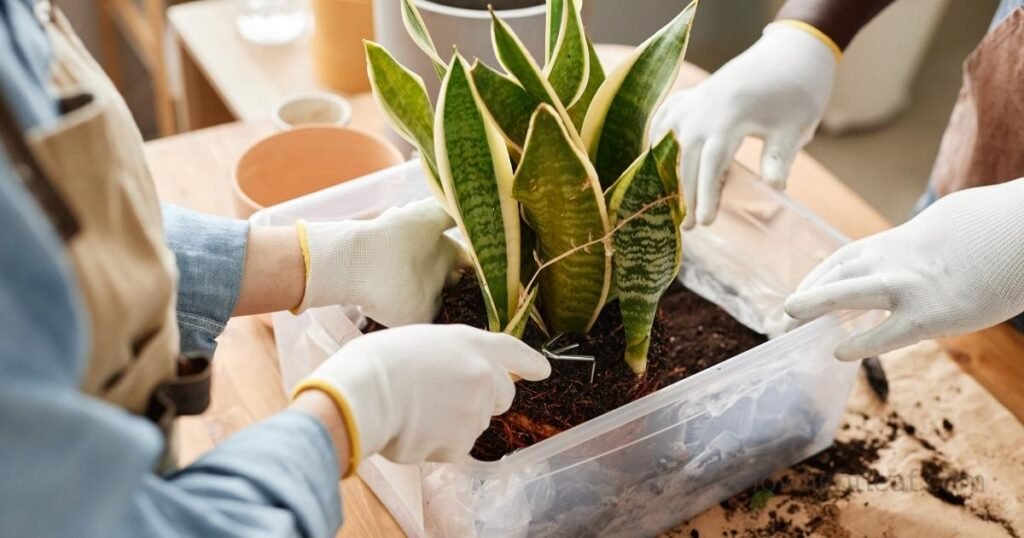
Repot a snake plant into cactus potting mix, or into two parts peat-free loam-based compost and one part horticultural grit, the RHS ratio. Use a pot with drainage holes that’s only slightly larger than the old one, so there’s little spare soil to stay wet.
Does snake plant soil need perlite?
No. Perlite is one way to add drainage, and Penn State suggests a potting mix with perlite. The RHS uses horticultural grit or fine gravel instead, and NC State notes that coarse builder’s sand drains a mix when it makes up nearly half. Any of the three works.
How often should snake plant soil be replaced?
Every few years is enough. Penn State says snake plants like fresh potting media every 5 years or so, though its author repots a dwarf ‘Hahnii’ every 3 years. The RHS waits until roots fill the pot or make it buckle.
How can I tell the soil is staying too wet?
Check with a finger before every watering, as the RHS recommends, and skip watering while the soil is still damp. Fungus gnats are another sign, since NC State says they favor moist, peat-based mixes. If the whole plant starts to lean, the RHS says to check for root rot, and why is my snake plant drooping walks through the checks in order.
The darker the corner, the leaner the soil and the more porous the pot should be. For the watering side, see how often to water a snake plant, and if leaves are already turning, start with snake plant yellow leaves. The same approach for other species is in best soil for ZZ plants, best soil for pothos and best soil for spider plant.

Ellie Marsh
Houseplant grower who spent years in a north-facing apartment. Writes practical care guides for low light homes, checked against extension and botanical garden sources.