Last updated on October 11, 2026
Closed terrarium plants need three things: they like steady humidity, they stay small, and they don’t need direct sun. Penn State Extension puts most good choices in two groups, moist woodland plants and tropicals, and names moss, lichen and ferns as natural fits. It also rules out succulents and cacti for a sealed jar.
If I were filling a first jar, I’d start with moss, a small fern, a dwarf nerve plant and a patch of baby’s tears. Those four share the same light and moisture needs, which matters more than how good each one looks on its own.
Closed terrarium plants that suit a sealed jar
Every plant here is matched to its Missouri Botanical Garden Plant Finder listing for light and moisture, plus the one thing that decides whether it can live under a lid.
| Plant | Light and moisture (source) | Fit for a closed jar |
|---|---|---|
| Mosses and lichens | Penn State Extension: thrive on moisture and in dim settings | Strong fit; good groundcover between taller plants |
| Table fern (Pteris cretica) | Missouri Botanical Garden: part shade to full shade, likes high humidity, avoid direct sun | Strong fit; pick a small specimen for the jar |
| Nerve plant (Fittonia albivenis), dwarf forms | Missouri Botanical Garden: bright indirect light, avoid direct sun; dwarf forms suit a terrarium’s humid air | Strong fit if you buy a dwarf form |
| Baby’s tears (Soleirolia soleirolii) | Missouri Botanical Garden: part shade to full shade, consistently moist soil | Good fit as a low carpet; Penn State uses it as a groundcover |
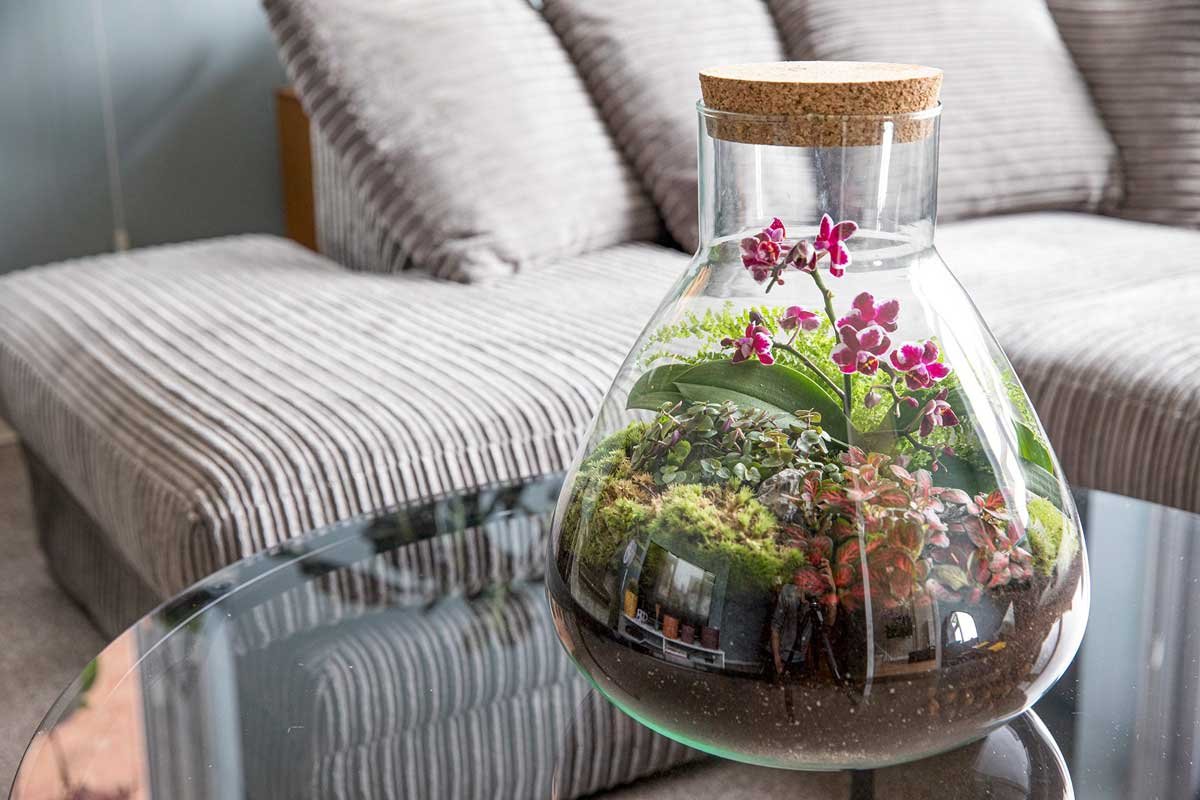
| African violet (Saintpaulia ionantha) | Missouri Botanical Garden: part shade to full shade | Good fit for a flower; Penn State shows one growing in a closed terrarium |
Grouping by need keeps a jar alive. Penn State Extension advises putting plants with similar light and moisture requirements in the same container, and choosing small, slow-growing or naturally dwarf plants that fit with room to spare. A plant that outgrows the glass turns a terrarium into a pruning job.
Plants to skip or watch in a closed terrarium
Some plants sold for terrariums clash with a sealed jar once you put their own care listing next to Penn State’s rules. None of these is a hard no except the first; the rest need a plan.
- Succulents and cacti: skip them. Penn State Extension says they do not make good closed terrarium plants and belong in an open terrarium or dish garden. For a dim room, see which succulents cope with low light in an open pot.
- Creeping fig (Ficus pumila): Missouri Botanical Garden calls it a vigorous, fast-growing vine, which runs against Penn State’s advice to choose slow growers. Use it only if you are happy trimming often.
- Polka dot plant (Hypoestes phyllostachya): Missouri Botanical Garden lists it as suitable for terrariums but says indoor plants want bright light with some direct sun. A closed jar should never sit in direct sun, so expect it to stretch unless the spot is very bright.
- Peperomia (Peperomia caperata): Missouri Botanical Garden advises letting the top of the soil almost dry before watering, which is hard to do under a lid. It suits a jar you vent regularly better than one that stays sealed.
Colored foliage needs restraint too. Penn State suggests avoiding too many variegated or colored plants in one jar, since the space is small and a few go a long way.
Where a closed terrarium should sit
A closed terrarium belongs in a bright room or near a bright window, never in direct sun. Penn State Extension’s warning is blunt: in direct sunlight the jar will cook.
Penn State’s test for a room is simple. If a houseplant already does well in that spot, choose terrarium plants with the same or brighter light needs. I lived for years with nothing brighter than a north-facing window, and in light like that the mosses, ferns and baby’s tears from the table make sense (the same light suits the potted low light indoor plants on this site), along with a dwarf nerve plant, which Missouri Botanical Garden says takes bright, indirect light from an east or north window. Use clear glass. Penn State notes that colored glass does not let enough light through for the plants to do well.
Mold in a closed terrarium: what the fog tells you
Mold in a closed terrarium most often comes from too much water or from something dirty going into the jar. Penn State Extension’s routine is to water gently, watch the condensation, and act within the first few weeks, when diseases typically take hold.
Start clean, because a humid, closed jar is an ideal breeding ground for pests and pathogens. Penn State Extension recommends washing your hands or wearing clean gloves, washing the container with soap and hot water, using a soilless potting mix with low fertility, and mixing in a handful or two of charcoal. It also notes that the old layer of rocks at the bottom is no longer thought to improve drainage. The full build order, layer by layer, is in how to make a terrarium.
Then water less than feels right. A mister may be enough at planting, and Penn State points out that adding a little water later is easy, while getting excess water back out of a sealed jar with no drainage hole is hard. If leaves are wet, let them dry before the lid goes on.
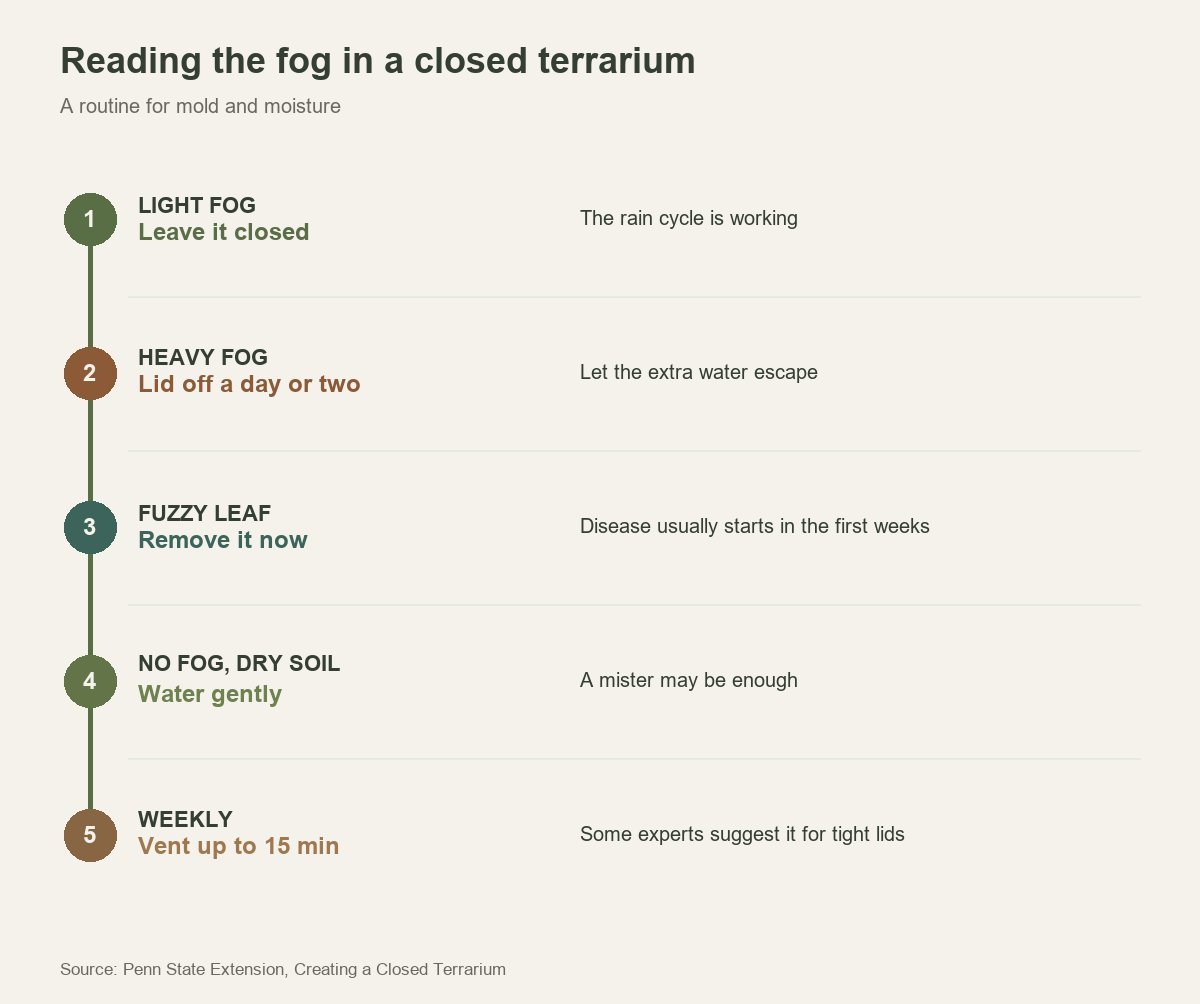
Watch the glass closely for the first several days, which Penn State says need your attention. Condensation that looks like a light fog means the jar’s rain cycle is working. Anything heavier, and the lid should come off for a day or two. If a leaf turns fuzzy or rots, pull it out right away; Penn State also mentions a diluted fungicide as an option. Once the jar settles, some experts suggest lifting the lid for up to 15 minutes a week to let fresh air in, which matters most with a very tight lid.
Pruning keeps the air moving. Penn State advises removing leaves that have yellowed, that touch the glass, or that are growing out of bounds.
Closed terrarium plants FAQ
Which is better, an open or closed terrarium?
An open terrarium is easier to start, while a closed one is easier to keep. Penn State Extension says open terrariums and dish gardens are simpler to create and can hold almost any plant, but a closed jar, once its rain cycle is running, needs very little care.
What are common closed terrarium mistakes?
The most common closed terrarium mistakes are direct sun, too much water and the wrong plants. Putting succulents or a fast-growing vine under a lid, using colored glass, or adding a dirty stone or figurine all cause trouble later.
How often does a closed terrarium need water?
A closed terrarium needs water only when the condensation stops, the plants droop or the soil feels dry. With a very tight lid, Penn State Extension says that may happen only once every four to six months.

Ellie Marsh
Houseplant grower who spent years in a north-facing apartment. Writes practical care guides for low light homes, checked against extension and botanical garden sources.