Last updated on October 11, 2026
The best soil for ZZ plants is a fast-draining, airy mix, like a cactus and succulent blend, or potting soil amended with perlite, pumice, or bark. Your ZZ plant (Zamioculcas zamiifolia) stores water and energy in thick, potato-like rhizomes just beneath the soil surface. That’s exactly why it tolerates drought so well, and exactly why dense, moisture-holding soil is the fastest way to rot it. The right mix protects that rhizome by giving it a real dry stretch between waterings instead of constant, low-grade moisture pressure.
This guide walks through the ratio that actually works and why it varies slightly between homes, what each ingredient does, whether cactus or succulent soil is enough on its own, which store-bought mixes are worth buying, what to use when repotting, and how to spot soil that’s quietly gone bad before it costs you the plant.
The 3 things ZZ plant soil must do:
Drain quickly — water passes through, it doesn’t pool on the surface
Keep air around the rhizome — loose structure matters as much as drainage itself
Hold enough structure — to support roots without trapping moisture around the rhizome
Everything in this guide builds on those three jobs. If a mix does all three, the exact brand or ratio matters far less than people assume.
Why ZZ Plant Soil Needs to Be Different
Most potting soil is built to hold moisture because most houseplants need steady moisture around their roots to keep growing. A ZZ plant doesn’t work that way, and using the wrong soil is one of the most common reasons it struggles. ZZ plants evolved in parts of Eastern Africa where rainfall is irregular and dry spells are normal, so dense, slow-draining mixes cause problems fast.
That’s why dense, slow-draining mixes cause so many ZZ problems. When the soil stays wet too long, the rhizome never gets a real dry window between waterings. Over time, that constant moisture pressure reduces airflow around the roots and raises the risk of rot. That’s why choosing the right soil matters far more than many beginners realize and it’s also why the ZZ plant care guide treats soil as one of the first things to get right before anything else.
What Is the Best Soil Mix for a ZZ Plant?
The short answer: a fast-draining mix built around a cactus or succulent base, plus extra aeration material and a small amount of structure. In practice, that usually lands somewhere around a 50/30/20 or 60/30/10 split, depending on how quickly your home dries the soil.
You’ll see slightly different ratios recommended in different places, and that’s not a sign anyone’s wrong. A hot, dry home can handle a chunkier mix than a humid one, and a peat-heavy potting mix usually needs more aeration added than a gritty cactus blend. The exact ratio matters less than whether the mix dries at the right pace in your setup.
If you’re unsure where to start, this type of mix is the best soil for ZZ plant care in most indoor homes.
DIY ZZ Plant Soil Recipe
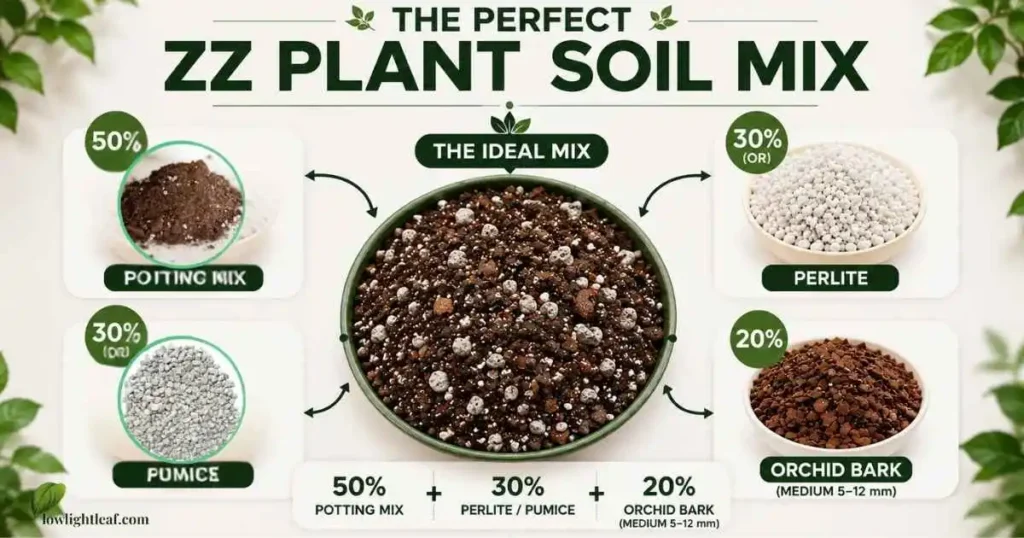
If you want to make the best soil for ZZ plant, this ratio is a dependable starting point.
- 50% potting soil or cactus & succulent mix — the base, providing some structure and nutrients
- 30% perlite or pumice — the aerator, keeping the mix loose and improving drainage
- 20% orchid bark or horticultural charcoal — adds chunk, slows compaction, and keeps air pockets open longer
If your home runs hot and dry, push closer to 60/30/10 so the mix stays extra airy and fast-draining. In a humid climate, or if you tend to forget waterings, 50/30/20 gives you a little more moisture buffer without becoming heavy. Neither version is more correct; they’re just built for different conditions.
This mix is designed for mature, potted ZZ plants. If you’re working with fresh cuttings, those need a different approach, propagating ZZ plants from stem or leaf cuttings requires an even lighter, faster-draining rooting mix before any root system develops.
What each ingredient actually does
| Ingredient | Role | Why It Matters |
| Perlite | Aeration, drainage | Cheap and widely available, though it can float to the surface over time |
| Pumice | Aeration, drainage | Heavier than perlite, so it stays put and holds up better long-term |
| Orchid bark | Adds chunk, slows compaction | Breaks down slowly, keeping air pockets open for years |
| Horticultural charcoal | Drainage, odor control | Also absorbs excess moisture if the soil ever runs wetter than ideal |
| Coarse sand | Budget aeration | Adds weight, but works as an affordable substitute for perlite or pumice |
| Coco coir / peat moss | Structure, light moisture retention | Use sparingly; too much brings back the soggy soil problem you’re avoiding |
If you don’t have one of these on hand:
| Missing | Use Instead | Trade-off |
| Perlite | Pumice or coarse sand | Sand adds weight, slightly less aeration |
| Orchid bark | Horticultural charcoal | Charcoal also helps control odor |
| Cactus mix | Potting soil + extra perlite | Needs closer monitoring of drainage |
| Pumice | Perlite | Lighter, may float over time |
Can You Use Cactus or Succulent Soil for a ZZ Plant?
Yes. If you want the best soil for ZZ plants without measuring individual ingredients, a cactus or succulent mix is one of the easiest options. A commercial cactus and succulent mix is consistently recommended across plant communities for ZZ plants for good reason: it’s already built to drain fast and resist compaction.
Two Easy Ways to Use Cactus or Succulent Soil
- Straight from the bag — works well in most homes, simplest option if you’d rather not mix anything
- Blended 60/40 with regular potting soil — adds organic content and nutrient-holding capacity if your home runs dry, or you’d rather not water as often as a pure cactus mix might call for
Succulent soil and cactus soil are functionally interchangeable here. If a bag says either, you’re still looking for the same traits: fast drainage and a chunky, airy texture.
Is regular potting soil ever enough on its own?
Not reliably. It holds too much moisture for a rhizome-storing plant, and using it unamended is the most common cause of soggy, slow-draining ZZ soil. If it’s what you already have, amend it instead of tossing it: mix in 30–40% perlite, pumice, or coarse sand to improve drainage and loosen the texture.
Best Store-Bought Soil for ZZ Plants
If you’d rather buy the best soil for ZZ plant instead of mixing your own, focus on what’s inside the bag rather than the marketing on the front.
Best Store-Bought Soil by Situation
Don’t choose a bag just because it says “houseplant soil.” Instead, pick based on which of these fits your situation:
- Best for beginners: a standard cactus & succulent mix. Reliably fast-draining, widely available, and forgiving while you’re still learning your plant’s watering rhythm.
- Best for very dry homes, or if you don’t want the mix drying too fast: a chunky tropical or aroid-style blend with visible bark, perlite, or lava rock. It holds a little more structure than a pure cactus mix without becoming dense or soggy.
- Best if you know you tend to overwater: a gritty specialty mix built around coconut chips, pumice, and crushed granite. Drains extremely fast, which makes overwatering harder to do by accident, though it can dry out faster than you’d like in a very dry home.
What to check on the bag:
- Visible chunky material, bark, perlite, or pumice, not a uniform, fine texture
- Peat moss listed low on the ingredients, not as the dominant component
- Labeled for cacti, succulents, or explicitly as “fast-draining”
What to avoid:
- Peat moss as the first listed ingredient
- “Moisture control” potting soil, formulated to do the opposite of what a ZZ plant needs
- Bags with no visible texture or drainage material at all
Best Soil for Repotting a ZZ Plant
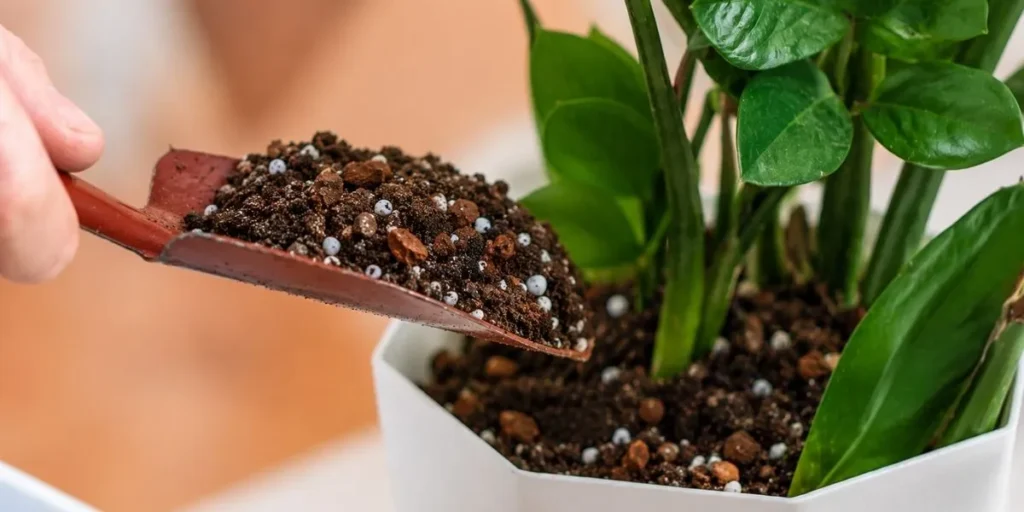
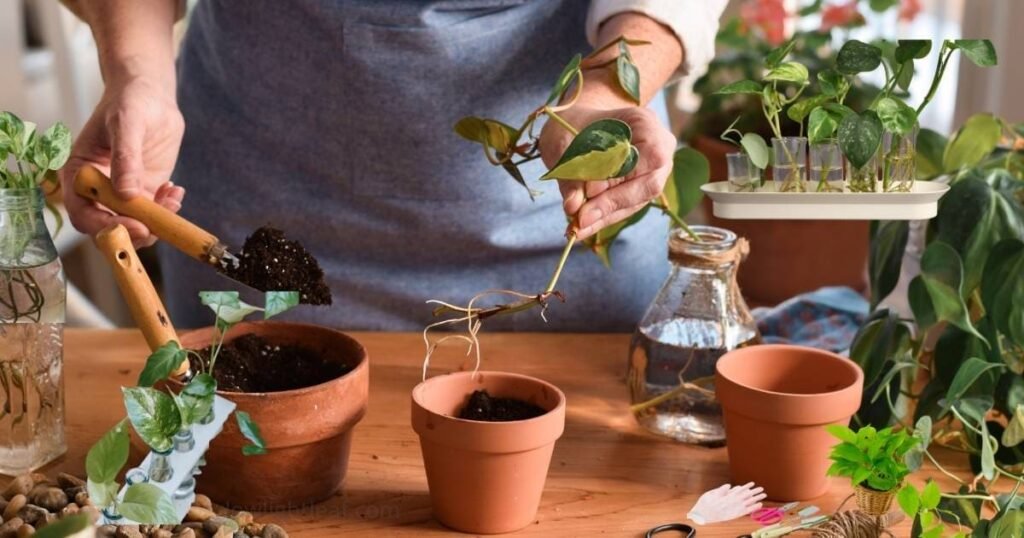
Repotting is your best chance to correct a ZZ plant soil problem, so it’s worth doing deliberately rather than as a routine chore.
When a ZZ Plant Actually Needs Repotting
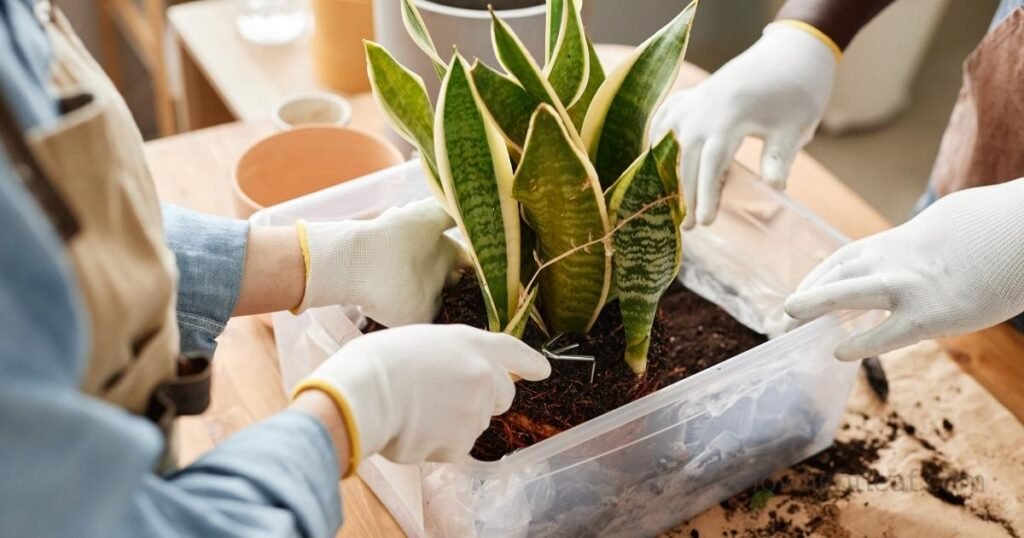
Repot when the plant is genuinely root-bound, roots circling tightly or pushing through the drainage holes, or roughly every 2 to 3 years to refresh soil before it compacts. A ZZ plant growing well in its current pot doesn’t need new soil just because time has passed. If it isn’t struggling, leave it alone, a rule that holds just as firmly when repotting a snake plant into fresh soil.
What Soil to Use When Repotting
The same fast-draining mix covered above. Repotting is also your best opportunity to correct a mix that’s been holding too much water. If your plant has started yellowing or staying wet longer than it used to, fresh, chunkier soil is often a bigger fix than simply watering less often.
When these soil problems continue for months, they can eventually slow new growth. If that happens, learn what to check when a ZZ plant stops putting out new shoots.
What matters during the process:
Pot size: go only 1 to 2 inches wider than the current pot. ZZ plants prefer being slightly snug, and an oversized pot holds more soil mass than the roots can use, meaning more trapped moisture sitting unused.
Drainage holes are non-negotiable. Even ideal soil eventually turns soggy in a pot with nowhere for excess water to go.
Rhizome placement: position it at or just slightly below the surface, never buried deep. A rhizome buried too far down stays in contact with moist soil longer, raising rot risk even in soil that drains well overall.
Watering after repotting: wait several days before watering again, especially if any roots were trimmed. This gives small breaks time to callus over before they’re exposed to moisture, lowering the chance of rot setting in right after a stressful move. For exactly how long to wait and when to resume a normal schedule, the ZZ plant watering and drying cycle guide covers post-repot timing in detail.
What to Do If the Rhizome Feels Soft or Mushy
If the rhizome feels soft, mushy, or smells sour when you repot, don’t put it back into the old mix and hope for the best. Trim away damaged tissue with a clean, sterilized blade until you reach firm, healthy material, let the cut areas dry for an hour or so, then repot into a fresh, chunkier mix and wait several days before watering. Acting at this stage is often what determines whether the plant recovers.
Pot Material Changes How the Same Soil Performs
Even the best soil for ZZ plants can dry at a different rate depending on the pot material you use.
Terracotta and unglazed clay are porous, so moisture evaporates through the walls as well as the surface. The same mix dries noticeably faster in terracotta than in plastic or ceramic, a forgiving choice if you tend to water a little too generously.
Plastic and glazed ceramic hold moisture longer, since nothing evaporates through the sides. With these pots, use a slightly chunkier mix or simply stretch your watering interval a bit longer than you would with terracotta.
If you’re using a decorative cachepot, keep the ZZ plant in a nursery pot with drainage holes inside it, then empty any excess water from the outer pot after watering. If your ceramic pot has no drainage hole at all, it’s better used as a cachepot than as the planting container.
Does Soil Need to Change Indoors, Outdoors, or in Winter?
The soil mix itself usually doesn’t need to change. What changes is how quickly it dries in different conditions.
Indoors: The biggest variable is light, not season directly. A ZZ plant in a bright spot dries its soil faster than the same plant in a dim corner, regardless of time of year. That is why light placement matters, ZZ plants are one of the most adaptable low-light indoor plants for dim corners and shaded rooms, but even they dry their soil faster in brighter spots.
In winter: Lower light and cooler temperatures slow the whole plant down, including how fast the soil dries. The mix doesn’t need to change, but expect noticeably longer stretches between waterings, soil that dried in ten days during summer might take three weeks in January.
Outdoors: Containers get more airflow and heat, which usually dries soil faster than the same pot would indoors. If you move a ZZ plant outside seasonally, the same fast-draining mix still applies, but expect to check soil moisture more often, rather than watering on the same schedule.
Does Raven ZZ Need a Different Soil Mix?
No. Raven ZZ, along with Black ZZ and Chameleon ZZ, needs the exact same soil as the standard green variety. The dark coloring is a pigment difference, not a different root or rhizome structure, so everything in this guide applies across every common ZZ cultivar without adjustment.
Variegated ZZ is the only small exception worth mentioning. Its soil needs stay the same, but brighter light is essential to maintain the leaf pattern. Because variegated plants have less chlorophyll, they’re often less forgiving of prolonged soil stress, similar to how snake plant varieties with variegated leaves need the same drainage discipline to stay healthy indoors.
ZZ Plant Soil pH: Does It Need Acidic Soil?
ZZ plants do best in slightly acidic to neutral soil, in the 6.0 to 7.0 pH range. Most standard potting mixes and cactus blends already sit comfortably inside that window without any adjustment from you.
In practice, pH isn’t where most home growers should start troubleshooting. If your ZZ plant is struggling, soggy soil, poor drainage, or incorrect light conditions are far more likely culprits. Check pH only after you’ve ruled out the more common causes, not as a first guess.
Why ZZ Plant Soil Changes Over Time
A mix that worked perfectly when you first potted your ZZ plant won’t necessarily stay that way for years.
Compaction happens gradually. Organic components break down, perlite settles, and a mix that started loose and chunky slowly becomes denser and drains more slowly. If your watering habits haven’t changed but the soil stays wet longer than it used to, compaction is the likely cause. Though before assuming it’s the soil, it’s worth checking whether yellowing ZZ plant leaves and slow drainage are pointing to a watering pattern issue instead.
Fungus gnats appear when soil contains too much peat or other organic material and stays damp. Small black flies around the soil usually mean the mix is holding more moisture than the roots need. Let the soil dry fully between waterings, and refresh the mix with less peat and more drainage material to address both the gnats and the underlying soil problem.
Common Soil Mistakes That Harm ZZ Plants
Dense, water-retentive soil. If the mix doesn’t drain within a reasonable window, everything downstream, rot, yellowing, mushy stems, traces back to this.
Pots without drainage holes. Even ideal soil eventually turns soggy with nowhere for excess water to escape.
Burying the rhizome too deep. Keeps it in contact with moist soil longer than necessary, raising rot risk even when the mix itself drains well.
Oversized pots. A pot too large for the current root mass holds more moisture than the roots can use, one of the most common and most avoidable mistakes.
Treating soil and watering as separate problems is a common mistake. Even excellent soil won’t compensate for poor watering habits, so it’s worth learning how often to water a ZZ plant instead of relying on a fixed schedule.
Signs Your ZZ Plant Soil Has Gone Wrong
| Sign | Likely Cause | What to Do |
| Soil stays wet more than 2 weeks after watering | Mix too dense, or pot too large | Let it dry fully; consider repotting into a chunkier mix |
| Sour or musty smell from the soil | Early-stage root rot | Check the rhizome; if soft, trim and repot immediately |
| Yellow leaves with mushy stems | Drainage problem plus overwatering | Stop watering, inspect roots, repot if rot is present |
| Soil hard, pulling away from pot edges | Mix has compacted with age | Refresh the soil at your next repotting |
| Small black flies near the soil surface | Fungus gnats from damp, organic-heavy mix | Let soil dry fully; refresh toward a more mineral mix |
| Water runs straight through without absorbing | Soil too dry and compacted, or too sandy | Break up the top layer, or bottom-water to rehydrate evenly |
Quick ZZ Plant Soil Checklist
Before choosing the best soil for ZZ plants, use this quick checklist to make sure the mix drains well and stays airy around the rhizome.
- Fast-draining; the upper soil should begin drying within a few days indoors, though the full pot may take longer depending on light, pot size, and material
- Loose, chunky texture, not dense or uniformly fine
- Contains perlite, pumice, or bark for aeration
- pH in the 6.0–7.0 range, true for most mixes by default
- Pot has functional drainage holes
- Refreshed every 2–3 years, sooner if compacted or depleted
- Rhizome sits at or near the soil surface, never buried deep
FAQs: Best Soil for ZZ Plant
What is the best soil for ZZ plant?
The best soil for ZZ plant is a fast-draining, well-aerated mix. A commercial cactus and succulent blend works well, or you can make your own using about 50% potting soil, 30% perlite or pumice, and 20% orchid bark or horticultural charcoal. The goal is to keep the rhizomes from sitting in soggy soil.
Can I use regular potting soil for a ZZ plant?
Not on its own. Standard potting soil usually holds too much moisture for a ZZ plant’s water-storing rhizomes. If it’s the only mix you have, improve drainage by adding 30–40% perlite, pumice, or coarse sand before planting.
Can I use cactus or succulent soil for a ZZ plant?
Yes. Cactus and succulent soil is one of the best ready-made options because it drains quickly. You can use it straight from the bag or mix it with a smaller amount of regular potting soil if your home is especially dry and you want slightly more moisture retention.
What is the best soil for repotting a ZZ plant?
Use the same fast-draining soil mix recommended for everyday care. Repotting is also the best time to replace compacted or waterlogged soil with a fresh, airy mix that improves drainage and reduces the risk of root rot.
Final Thoughts
Good soil is the foundation of healthy ZZ plant growth. Get the drainage and aeration right, and your ZZ plant becomes much more forgiving of occasional watering mistakes. Keep it in dense, slow-draining soil, and even careful watering won’t fully prevent root problems.
The best soil for ZZ plants doesn’t need to be complicated. Start with a fast-draining cactus blend or your own 50/30/20 recipe, use a pot with drainage holes, and refresh the soil every couple of years before it becomes compacted. With the right foundation in place, every other part of ZZ plant care becomes much easier.

Ellie Marsh
Houseplant grower who spent years in a north-facing apartment. Writes practical care guides for low light homes, checked against extension and botanical garden sources.
Explore more: